
This is about an event I went to around three weeks ago. I didn’t get around to publishing it at the time but now, seeing the exclamations and arguments around social media after the events of the last few days, I thought I’d better get on with it, but with a message from ‘Breaking the Silence’, an organization of Israeli army veterans, at the top, to remind us all that we know, and have known, always known, what happens if you build anger, grief, frustration and fear in a community, and then force all that heat into a small space.
![Message from [Breaking the silence]](https://kaygreen.blog/wp-content/uploads/2023/10/387822745_315399401136076_2637856385990967299_n.jpg)
I’ve also written a second article, for people who don’t know why socialists appear to be ‘justifying’ or ‘excusing’ violence and horrors. Generally, they are not – but I can see people are finding it hard to believe.
To see the second post, the one I wrote after this week’s horrors, please click here
The event was laid on so we could hear from a delegation of Palestinians from Shu’fat refugee camp, including a teacher, a doctor, a Community Centre worker and a committee member who I’m guessing is the equivalent of a council leader in a UK town (Shu’fat long ago ceased to look like a ‘camp’. It has rough-and-ready apartment blocks over ten storeys high). Amongst the sofas as we gathered the delegation were chatting. Sometimes, someone would say something then go into a huddle with others to create a translation. When the event – a panel led discussion, started, some of it was delivered in Arabic, with a following translation into English, so we got to experience the tone and the emotion first, then the words that went with them.
They were preparing to tell us the story of a group of people expending vast amounts of human energy and brilliance trying to create a decent place to live in an overcrowded cage surrounded by vindictive, armed guards.
How did they get there?
So have I got this straight? A people who had gathered from around the world into a place that three other, unaffected countries had approved of as being for them, took military action to clear out the people who had been living there all along. They called this ‘a land without a people for a people without a land’.
The three other countries were Britain, the USA and France, putting their heads together and deciding how to tidy everything up after World War II. The people without a land were Jewish people who had been encouraged to emigrate to Palestine, where Israel was to be created, and the people who got cleared out were Palestinians, born in Palestine, who weren’t asked what they thought about all this.
It’s estimated that in 1948, around 750 000 Palestinians were made into refugees in what had been their own land. Are we to be surprised that things just didn’t shake down and become okay in a few decades?
For most of my life, the UK news has presented the on-going Israel/Palestine situation as a problem of two peoples who mysteriously just won’t stop fighting. For all of that time, Palestinians have been shunted into progressively smaller areas by on-going Israeli settlement building, or corralled into closed areas where, over those decades, they’ve built houses and flats under the eye of the illegally occupying Israeli army, on the land that was the tent-cities they were originally driven into.
Israel has military checkpoints, walls and wire fences to keep them in. Israel calls the military that act as jailers round those camps ‘The Israel Defence Force’ (IDF). Israel has become a rich and influential country over the years, a powerful producer of military and surveillance technology, sitting at the tables of the big world arms traders.
Most Palestinians have become impoverished and desperate, kept short of supplies and opportunities, and often left without water or electricity in their overcrowded, penned in concrete ‘camps’. When I was young, BBC reports always somehow gave me the impression that it was the Israelis who were under siege, that the walls and fences and checkpoints were built around Israeli towns, to keep marauders out, rather than around the pens they had driven others into. It really is the Palestinians, now, who are ‘a people without a land’, but you’d never know that, if you depended on mainstream news for your information.
Shu’fat

The original inhabitants of Shu’fat were Palestinians living in Jerusalem. They were driven to the site along with all their furniture and belongings when they were told to leave Jerusalem, and that they would be taken to a place where they could have their own homes and land. Shu’fat was supposed to be a transit camp, but a war happened, turning Israeli attention elsewhere, and the onward allocation never happened.
Over the years, tent-city has become concrete city. There was no possibility of growing outwards, so it just kept growing upwards. The Shu-fat refugee camp is ten minutes’ walk from Jerusalem but, if you live in the camp and have a job in Jerusalem, you have to get up at 5am, and run the gamut of a bottle-neck of volatile and unpredictable check-point guards to get there, because the ‘camp’ is walled in, and the checkpoint is the one and only way in or out.
The Community Centre
If you want a decent, workable community you have to try and make life bearable for your people. In Shu’fat, that means running a community centre that caters for the disabled – why so many disabled people? Why so many children missing and eye or a limb, for example? Why so much PTSD to cope with? Because living in a Palestinian refugee camp means living with the daily possibility of being arrested, shot at or beaten up by soldiers.
Why so much violence? It seems clear that neither Israel nor Palestinians are able to stop it – and the global powers that be just keep waffling on about ‘peace talks’ and a ‘two state solution’ (that is, drawing another line – that post-colonial non-solution that always leads to things like the situation we see now in Israel/Palestine.)
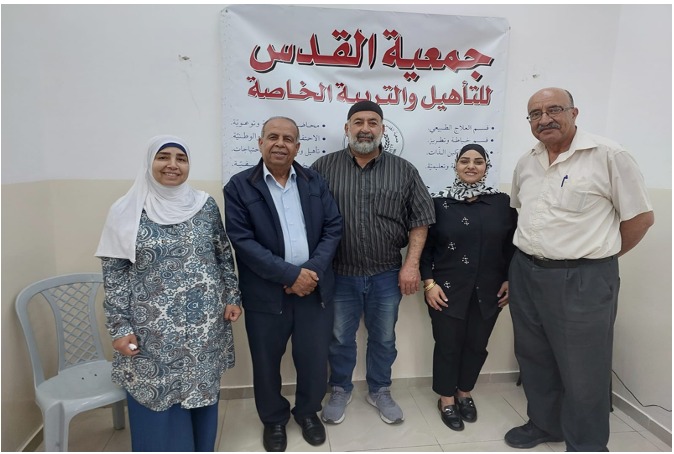
The message of this Palestinian delegation is that they were all born there – Israelis and Palestinians alike. They all need peace, freedom, and an end to the walls, guns and fear their history created. They are stuck. Maybe they need other countries to come together and help broker a real solution – but so far, our own politicians haven’t attempted to solve the real problems – such as dealing with all the paranoia and anger and violence this horrendous situation has generated over the decades.
Maybe the UN, or whoever is supposed to be in charge of such endeavours should get some of the women of the Shu-fat Community Centre to help them work out how to do it. The Centre does something called ‘psycho-social’ work – that involves things like bringing together kids who’ve seen their parents burned to death in their homes by Israeli settlers, or who’ve been repeatedly beaten up by soldiers. It involves trying to persuade those traumatised kids not to grow up and become the vengeful furies that the frightened Israeli bullies fear would come to get them if they opened up the camps.
A glimmer of hope?
Israel is not a happy country. I spoke to some Jewish Israeli women at a conference last autumn and they said increasing numbers of Israelis are sickened by the deadlock they’re in. Whilst some are in despair and talk of leaving Israel, others say they want to tear down the walls and find a way to make peace. The Shu’fat delegation spoke of an Israeli doctor who came to help out at their community centre for a while – but then she got threatened by some of those frightened Israeli bullies, and stopped coming.
Israel’s government is not stable. Troubled political parties vie with each other to be the ‘firm hand’ that will keep Israel safe by controlling the Palestinians – but that one idea is wearing thin. Maybe a time is coming when Israeli people themselves will rise up, demand peace, and learn to live together – that is, a ‘one-state solution’.
Until they do that, both Palestinians and Israelis are, in a very real sense, ‘a people without a land’, one side imprisoned by fear, the other by guns and walls. Even as I was writing up Saturday’s event, and wondering if the troubles now are that ‘darkest hour’ that’s ‘just before the dawn’, news came in from another walled-in camp, Jenin…

********************
Dear Reader,
Times are hard, and so the articles on this site are freely available but if you are able to support my work by making a donation, I am very grateful.
Cheers,
Kay
********************
 Kay Green