
(well, in a few local social media groups, anyway)
On August 12th 2025, Hastings’ local, volunteer-run community newspaper included a feature by the local Women’s Rights Network that set out the views of the women’s rights campaign following the Judicial Review of UK Equality law.
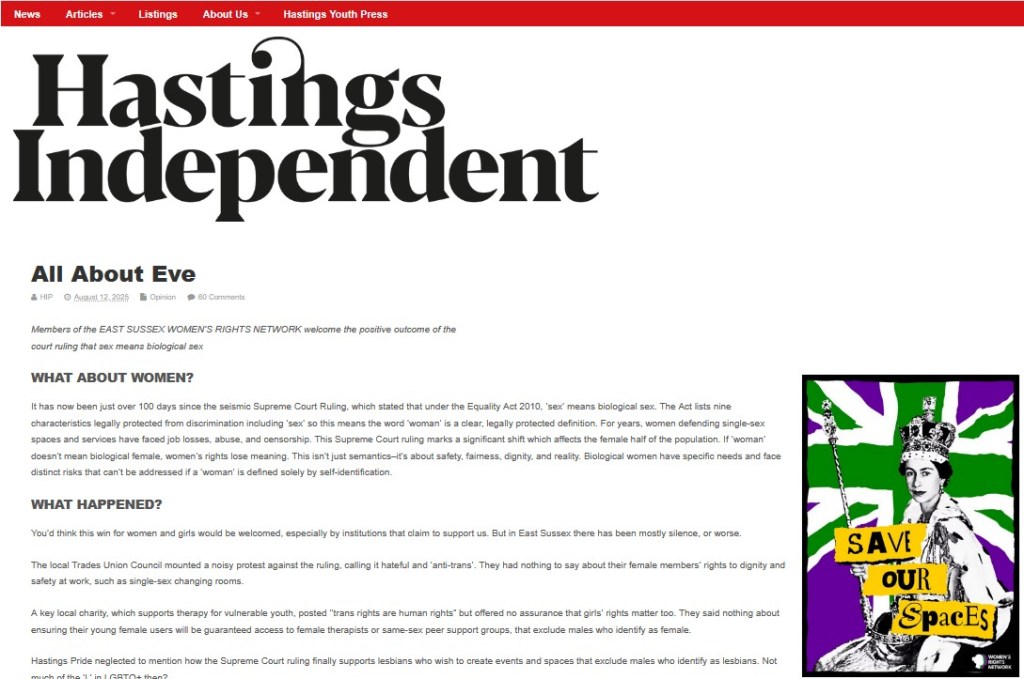
Lots of (virtual) shouting occurred. The two contesting views are something like this:
STORY ONE
The article spurned most of the post-modernist mind-numbing language of gender ideology in order to do some plain speaking about the consequences of the Judicial Review for women and girls, particularly lesbians. If you can tolerate such plain language, it’s easy to see that history, the legal record and just about anything about women that you care to look up in the Office of National Statistics all back up one very clear story: that women and girls are safer and more able to thrive if at least some single-sex spaces and services are available to them.
It then takes only plain logic to understand that you can’t talk about, defend, or develop single-sex spaces and services if you’re not allowed to call males male and females female. The women who wrote the article were doing that in order to explain the advantages for women of having the law concerning single-sex spaces and services clarified.
~~~
STORY TWO
If, on the other hand, you use the language and practices of gender-ideology that so effectively put a smoke screen between the reader and many women’s actual experiences, you will, as whoever wrote Hastings TUC’s response to the article did, conclude that the article is celebrating all the allegedly terrible things that the Judicial Review statement did to trans and non-binary people by allegedly excluding them from single-sex services.
That’s an odd idea for two reasons: firstly, as well as a section on sex-based rights, the Equality Act also contains a section for trans people, allowing them to set up and ring-fence their own services, as women have so often done; and secondly, no-one – absolutely no-one – is excluded by law from single-sex spaces or services. All the Judicial Review did was confirm that anyone – men or women, can, when they need to, exclude members of the opposite sex from their own spaces. After all, what else could ‘single sex service’ possibly mean?
That, at root, was the main point the Judicial Review was making. For the last decade or so, organisations like Stonewall have been misrepresenting the law, and telling trans and non-binary people they can use services according to which sex they are (currently) identifying as. As a result of the Review, they are now left with the option of using the many gender-neutral (mixed sex) services that have sprung up in recent years, using the services that match their actual, biological sex, or setting up their own, trans-oriented ones.
That is not the same as being excluded but nor is it using whichever ones they like, regardless of sex. No-one is supposed to do that.
~~~
Various local groups and individuals who consider themselves very progressive, set up a hue and cry. Prominent among them was Hastings Green Party. (The Green Party nationally is still spending a large proportion of its energy and funds trying to silence its own members on the subject of biological sex).

Amongst the miles and miles of social media threads that were generated, someone asked the Hastings Green Party to explain their objection to that newspaper article. The GP responded with a whole list of objections, each one more arcane than the last, that sprang from this starting premise: that the ‘Redefinition of “woman” as exclusively “biological female”’ is a transphobic theme/trope.‘
And that really is the key to everything that follows. They really believe the world has ‘gone beyond’ the assumption that when someone says ‘woman’, they mean ‘adult human female’. They then go on to get seriously offended by ‘misgendering’ (that is, talking about categories of people according to their sex, when you’re trying to discuss the law as it relates to sex); assuming lesbians are female (they are – that’s what ‘lesbian’ means), and calling ‘gender identity’ regressive (it is – we discovered back in the 20th century that women could have short hair and wear dungarees and learn to do plumbing and men could get dramatic perms and wear nail varnish and have bags of fun without anyone needing to change sex to do so.)
The language of queer theory
If you look at the equality statement on the Green Party’s website, you could be forgiven for thinking it comes from another planet. Although they use a lot of the same words we do, they string them into sentences that bear little resemblance to – well, anything, really but if you want to know who is being regressive, the best thing to do is try telling the Green Party, or HTUC, that in the real world, people have set to and over the last few years, have been solving the issues that come up because of the increasing numbers of trans people – gender neutral loos is one example, new categories in sport is another. Most sporting associations have now set up or are planning ‘open’ categories, which will run alongside women’s sport, so that those who want to play in a mixed sex competition are free to do so.
So there is absolutely no need to keep bashing on about ‘exclusion’, and to pretend that there is still no evidence for things like the dangers of mixed sex sport, or putting rapists in female jails. Nor is there any point in trying to make the problems go away by telling people who don’t agree with you to shut up.
Or telling people they’re not allowed to use pronouns to indicate people’s sex. They can legally do so when they need to make that distinction, even if it happens to offend you.
In conclusion
The ‘trans’ situation is not really that difficult. The problem ‘trans rights’ campaigners have is that if they drop all the smokescreen language and say plainly what they want (free access for males to female sports, politics, hostels etc and for women to stop talking about why sex matters to them) – most people just say ‘no’. That’s called democracy, and they can live with it. Ask all the trans-sexuals who have managed to live with all that since forever.
As for the practical issues faced by trans adults, the real world is well on the way to finding answers.
There is another group though, who have a right to be angry and upset, and will continue to need help and support. They are those young people who were taught from an early age that ‘changing your sex’ is the answer to a whole range of problems.

They were betrayed — but not by the women’s rights movement. They were betrayed and are being betrayed by those who continue to insist that binders, cross-sex hormones and cosmetic surgery are safe, reversible, and can solve all their problems. There is now bags of evidence that that just is not so.
They have a right to be angry and upset — but there is no point in shooting the messenger – the Judicial Review confirmed that you can dress as you wish, call yourself what you wish, and even go for surgical and hormonal treatments that make you look and feel different. The law will protect you from discrimination if you do so — but you just cannot magically become the opposite sex. That is not going to change, and no amount of yelling at feminists will make it so.

All we need to do now is persuade those nervous organisations and publications that keep bowing to trans rights activists that they need not be afraid of a bunch of very noisy bullies. Those of us who’ve been campaigning to uphold sex-based rights for years know all too well that although the noise is ghastly, it very quickly dies down; they’ll move on to bully someone else and no-one except you even remembers you got yelled at.
********************
Dear Reader,
Times are hard, and so the articles on this site are freely available but if you are able to support my work by making a donation, I am very grateful.
You can make one-off or monthly payments by BACS to Mrs K Green, Sort: 07 01 16, Acct No: 43287058, Reference: blog
Or via Paypal…
Click here to donate via Paypal
Another great way to support this, and other independent blogs you read, is liking and sharing on social media, signing up for email updates, or by emailing a link to friends.
Cheers,
Kay
********************
 Kay Green