
All human life on the planet is born of woman – Adrienne Rich
That quote introduces the editor’s column in the latest edition of The Radical Notion which I intended to lose myself in, but people just kept lending me books, and suggesting I read books, some of which were immediately irresistible and so the pile got intermingled in my mind, and so here I am trying to review it along with Woman on the Edge of Time by Marge Piercy, BROADWATER by Jac Shreeves Lee and Mornings in Jenin by Susan Abulhawa, with one or two other recent reads thrown in. Here goes – hold on tight – it’s a switchback ride, a rolling review…
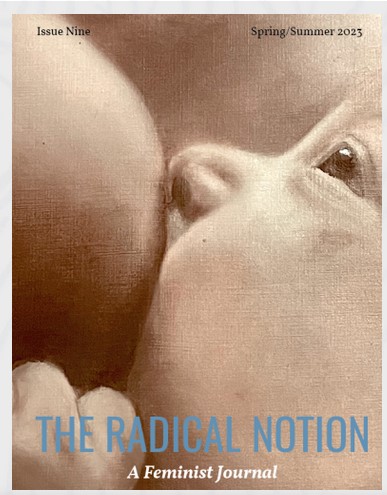
THE RADICAL NOTION is a broadly, sometimes – twice-a-year magazine which is always a rich feast of feminism: politics of, history of, analysis of and stories of. Every time an issue drops on my doormat, I fear disappointment. I think, surely you’ve covered all the fascinating stuff by now. Surely, this one will be at least a bit repetitive. But yet again, no. The theme of this one is motherhood and, despite being a mother and a grandmother, and one who did a lot of talking, studying and thinking each time there was a baby on the way, there is new stuff here that I needed to read, and much that I enjoyed being reminded of.
As well as the themed learning THE RADICAL NOTION brings, I love those snips and notes that you need to take away and think about – such as note 1 on page 7: ”our modern society judges people by their ability to be productive and socially compliant. I think that social compliance also has the nuance of power dynamics, by which a person or group can achieve influence … the process, even if pursued honestly for good ends….” At which point I dropped the magazine and went back to think about what the people running the mental health system in Piercy’s novel thought they were trying to do, and those who talked of millkmaids and chickens round the door, when teaching Broadwater Farm kids ‘their’ history…

Meanwhile, BROADWATER has stories of people in a community in a constant state of trying to heal – because race riots, and the criminalization that resulted, because Windrush, because the austerity years – Broadwater is constantly trying to heal from one trauma in the midst of another. We see what used to be called ‘the battle of the sexes’ – women trying to please and appease their men; but also amongst Black men, gay men, and women, those who understand the larger fight, trying to save each other.
We might fear communities where deprivation and austerity create violence and criminality, we might idealize communities where those same forces create love and solidarity: these stories tell us that those are the same communities, and in many ways, those are the communities where strength grows. Pity those who live in fear in gated defence of wealth.
Compassion and empathy are never wasted but, as with so many books in recent years, I experienced a blip of anxiety at — not misplaced compassion, but misconstrued compassion — for a ‘little girl trapped in a boy’s body’. Jac, please don’t frame it that way. So many well-meaning writers coming up with lines like that, apparently unaware that such comments feed into the alienation and vulnerability, the excruciating body-image problems adolescents are so prone to. What is perhaps even more tragic is that such comments both grow out of and re-amplify the belief those youngsters have that they are surrounded by enemies, that they must fight the world, as well as their bodies. How utterly terrifying that must be.
Speaking (obliquely) of which… The Ink Black Heart I have already reviewed. See here, why it made me burn with a need to address what online ‘communities’ can do and be…

Mornings in Jenin made a time-traveller of me. The news report images of Beirut were my first real-time experience of the way modern warfare can relentlessly reduce a city to rubble, and do so with impunity if enough people think it’s okay because it’s ‘somewhere else’. I was a teenager then, and switched on enough to have a ‘Yasser Arafat scarf’, and I remember freezing on the spot when the newsreader said “As we speak, Arafat is fighting for his life in the Golan Heights.”
I think that was the first time I’d had the direct experience of understanding that war kills real people, not just endlessly reincarnated Hollywood characters. It would be years more before I got an informed political understanding of what was behind those headlines. When the time came to wake up, it was BBC reporters who did it for me. I was watching a BBC video clip of uniformed Israeli forces violently hurling young men – teenagers – into the back of unmarked vans in a night time street in Jerusalem. I remember realizing the BBC voice-over did not match what I was seeing. The reporter was talking about something tremendously abstract – Arab terrorism was it, or had they moved on to saying ‘Islamic terrorism’ by then? But not talking about what I saw, which was boys being violently kidnapped.
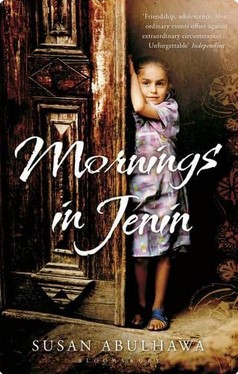
The reason Mornings in Jenin is one to go back and read again is that as well as the human story and the historical record that make it valuable, it’s also the best illustration I’ve seen of how violence breeds violence, of how the abused becomes the abuser. It carries you beyond ‘taking sides’, and asks you to think about how none of these horrors are about which side is evil. If you give humans – any humans – a hard time – in whatever way – and then give them power over others who they are invited to see as less important or less legitimate, horrible violence happens. So the Nazis did it to their own, so that their own would do it to Jewish people, and then those traumatized Jewish people who became Israeli did it to their own so they would do it to Palestinians, and so on down the line of horrors.
It’s what the modern, Western nations do to their own armies and police, so that they will do it to us. It is what we have to stop. Don’t waste time on who’s to blame, rather, tell me how we stop it.

Any damn way we can find, says Woman on the Edge of Time. This sci-fi novel by Marge Piercy, famous in its time (the 1970s) and still revered now, has become that odd creature, a predictive novel where the voice of the past, talking over your head as it were, tells you about times just a little way ahead of you. As Piercy writes in her introduction, ‘the point of writing about the future is not to predict it. I’m not pretending to be Nostradamus … the point of creating futures is to get people to imagine what they want and don’t want to happen down the road, and maybe do something about it.’
What‘s fascinating about Piercy’s characters is that they are ‘trying to exist’. They are actively trying to invite people into their respective imaginary futures, to warn or to inspire. Inspiration. My goodness, we need a shot of that now! Having lost our battle for the Corbyn-led Labour government, I look at Starmer and Co in their desperate attempts to inspire people with endless lists of pledges, broken as soon as they’re made, and I note that the man who did so much to inspire the Black rights movement in the United States patently did not have a ten-point plan – he had a dream, and he shared that dream, and helped to ignite a movement.
The bits I didn’t like in Piercy’s book (such as that strain of 1970s feminism that used to come across as ‘women must escape from being mothers’, which now looks like something scarily close to the trans-humanism of Matrix-related ideologies, and the stuff Judith Butler and co hurled at us, such as sex-denialism) … the bits I didn’t like were as important as the bits I did, because as Piercy’s introduction explains, a good-quality dreamed-up world helps you work out what you want, what you don’t, and why, so I really enjoyed it, ever inter-intermingled with those radical notions spilling out of Radical Notion #9 such as, on p45, “in any situation where there’s a meeting of people, the side that cares the least holds the balance of power.”
Except of course, in those magical moments were people who care most come together and become a movement. To do that, you need to have a dream, and share that dream…
Please read books. Read real, realistic, predictive, fantastic and reflective books, feed your dreams, and when you figure out how, please take action. No one person can save the world but let’s all have a good long think about what each of us can do or say to encourage the birth of the world we’d like to bequeath to our grandchildren.
********************
Dear Reader,
Times are hard, and so the articles on this site are freely available but if you are able to support my work by making a donation, I am very grateful.
Cheers,
Kay
********************
 Kay Green