
When it comes up in conversation – or worse, as it does all too often, in confrontation, it’s always difficult to explain the distinction between traditional, class-based left politics and the post-modernist, identity-based kind (often called ‘progressive’). Trying to do so can seem like a pedantic intervention, and often gets those who don’t know much about either calling you out for ‘lefty factionalism’ or ‘culture wars’ but, looking at the way these things play out in so many organisations, the Green Party being a significant current example, making that distinction is vital.

Here’s why…
I read a modern, groovy US-sourced book about Palestine. It was very, very good, and likened Palestine to ‘Turtle Island’, the country on which another country is busy imposing itself. (Turtle Island being the name some indigenous activists give to North America, when they wish to refer to something older and deeper than the United States). The book was also very progressively right-on and authentic, as it was written by a Palestinian woman.

I had mixed feelings about the author’s post-modern, identity-politics based approach though.
Click here to read my review of Elia’s book.
… but this week, another ten migrants died in the English Channel. Hastings will have a gathering to salute them on Friday.
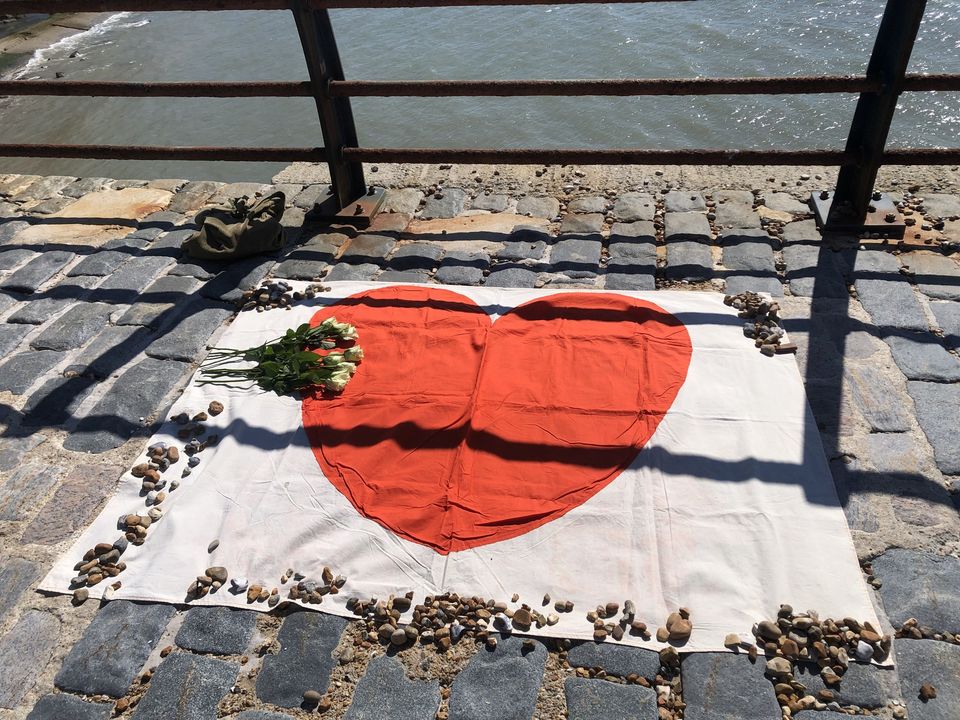
One of the features of this particular tragedy is that we heard that those who drowned were women and girls, and that one of the women was pregnant. It’s unusual to get even that much detail about migrants who die trying to cross the water. That’s one of the reasons some people in Hastings took to looking out for the little boats, and running down the beach to say ‘hello’, help them onto the shore, racing to get sufficiently ahead of the police to give them a dry coat or blanket and if possible, food and drink, before the police arrive and they disappear into the system.
Hastings says goodbye to Amooz and Samia
It felt important to see their faces, and call them by their names, before the BBC and the papers got onto the story. When the beach lookouts manage to do that, the migrants sometimes have names and nationalities when the story goes around Hastings, at least. This week’s women and girls though, died before we got that far. Perhaps that’s why I’ve had Woodie Guthrie’s Deportees song going round in my head this week.
This is about as much as I could remember, too.
All you have to do is exchange ‘boat’ for ‘plane’, and ‘migrants’ or ‘refugees’ for ‘deportees’, and the song lives again. Here are Guthrie’s words in full…
Plane Wreck at Los Gatos
The crops are all in and the peaches are rotting,
The oranges piled in their creosote dumps;
They’re flying ’em back to the Mexican border
To pay all their money to wade back again
Goodbye to my Juan, goodbye, Rosalita,
Adios mis amigos, Jesus y Maria;
You won’t have your names when you ride the big airplane,
All they will call you will be “deportees”
My father’s own father, he waded that river,
They took all the money he made in his life;
My brothers and sisters come working the fruit trees,
And they rode the truck till they took down and died.
Some of us are illegal, and some are not wanted,
Our work contract’s out and we have to move on;
Six hundred miles to that Mexican border,
They chase us like outlaws, like rustlers, like thieves.
We died in your hills, we died in your deserts,
We died in your valleys and died on your plains.
We died ‘neath your trees and we died in your bushes,
Both sides of the river, we died just the same.
The sky plane caught fire over Los Gatos Canyon,
A fireball of lightning, and shook all our hills,
Who are all these friends, all scattered like dry leaves?
The radio says, “They are just deportees”
Is this the best way we can grow our big orchards?
Is this the best way we can grow our good fruit?
To fall like dry leaves to rot on my topsoil
And be called by no name except “deportees”?
In the song, Guthrie is writing about Mexicans, an oppressed, racialised group in the United States, but in that book I mentioned above, he becomes ‘a part of the problem’. Concerning his now world-famous anthem, This Land is My Land, Elia writes, ‘Guthrie’s song was meant to be critical of private property but by asserting “public” (settler) ownership of the land by Guthrie and his listeners, it basically reinforces colonial entitlement and denies the indigenous rights to their homelands.’
Goodbye to Arwa and goodbye to Dalia
That’s why I’m so glad my back-brain dug up the Deportees song this week, when the tears were falling for those women and girls who died in the channel. It makes it clear that back in the last century, when Guthrie was writing his songs, before identity politics had come along to chop us into ever-smaller defensive identity-groups, Guthrie was on the side of all oppressed peoples, be they migrants to the land he was born in or descendants of those who were there before him. To deny that is to deny natural, class solidarity in the face of the enemy – the enemy then and now, the same enemy – the force of neoliberal capitalism, which is destroying us all.
Let’s learn the difference between socialism and identity politics. Let’s improve and foreground our anti-racism and anti-sexism work as we build the socialist movement that allows all peoples, migrant and indigenous alike, to fight back against the forces that would destroy all of us.
********************
Dear Reader,
Times are hard, and so the articles on this site are freely available but if you are able to support my work by making a donation, I am very grateful.
Cheers,
Kay
********************
 Kay Green