If you were a Labour Party member during the leadership election and the early days of Keir Starmer, you’ll remember all the wry jokes about his stated aim of creating ‘a party of unity’. We very quickly saw that his method of achieving this was to root out and expel anyone who wasn’t his preferred kind of party member.
Nevertheless, looking round social media this morning, I feel as though he has achieved a far greater unity. My interests cover quite a few areas of politics but every group I visited was having the same conversation – about their particular important people who’d been, or have said they’re willing to be, arrested rather than accept this government’s view of who the goodies and baddies are.
So there we have it. Starmer is on the way to creating unity way beyond the Labour Party – huge sections of society united in their belief that this government is badly wrong. And it’s not just Starmer. These days, if anyone talks about international politics using the terms ‘us’ and ‘them’, I always need to know – do you mean the people, or their government because in most cases, those two groups are near diametrically opposed.
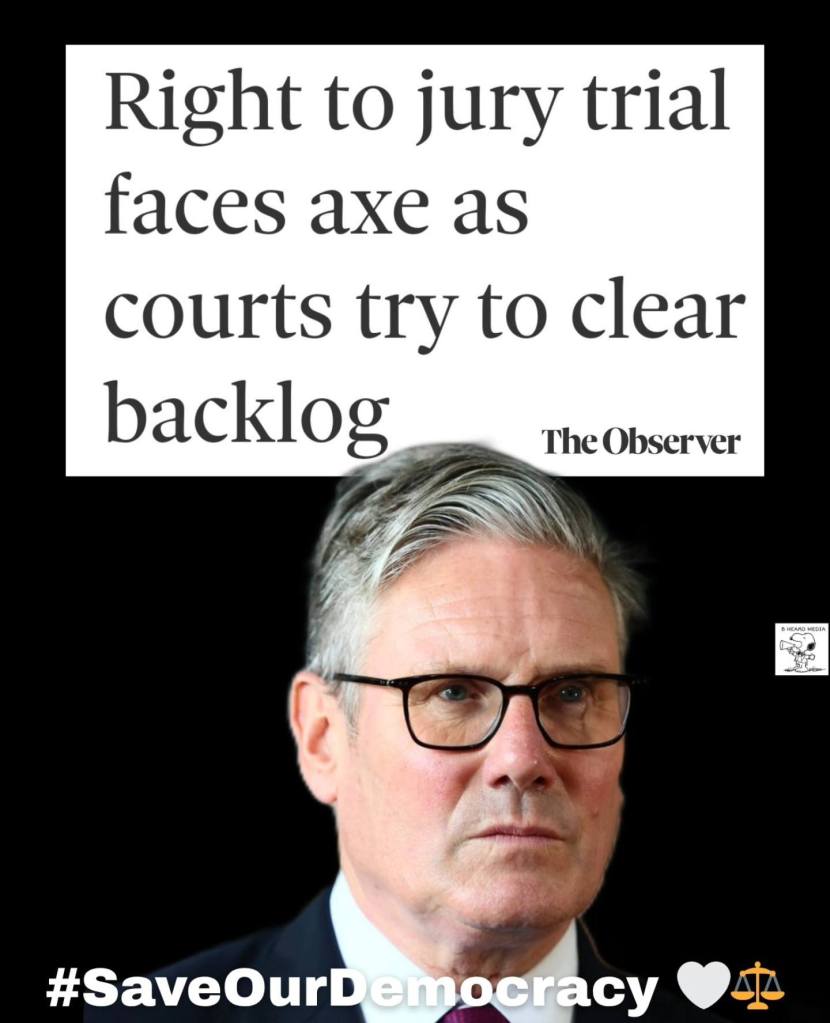
Isn’t that the real reason unpopular politicians seek ways to avoid jury-trials? They want a verdict decided by their own definitions, not everybody else’s.
That being the case, this is a good time to review some of the words that politicians habitually use in a way that isn’t what proper people (ie, the rest of us) would assume. I’ll start in the history books and work up to now, to outline the examples I think are still particularly important.
Mutiny
The most extensively covered ‘mutiny’ in my history books is the ‘Indian Mutiny’ which, at first glance – and when you study it in more depth, appears to be Indian people getting together to try to stop the British stealing everything they owned. More recently, it tends to be used a lot in party politics, when leaders fail to drag their membership into agreement with them – such as recently happened with Starmer’s Welfare Bill – or in the civil service. We’ve heard of several such events recently, where civil servants are unhappy that they’re being implicated in government law-breaking.
So mutiny means a failure to see the bosses’ point of view when the bosses are blatantly doing something that’s bad for you.
Colonisation
The tendency of the British establishment to present mutineers as mad, bad, terrorist types can be seen in records of British colonisation of India, Australia and America, as well as in the ‘slave mutinies’ which, even now, history books tend to leave out of their tales of how slavery was supposedly defeated in America.
It’s true that first nations and slaves tend to do ever more desperate things to fight off their oppressors, but this is rarely described as how impossibly badly-treated humans behave. The whole idea is turned on its head, with colonists presenting themselves as the civilised force whose iron-fist management is essential because the indigenous population are such savages (see just about any reports coming out of the Israeli establishment just now for up-to-date examples).
Hate speech
In the modern world, most people are far less tolerant of violence than their politicians, and are shocked and angered by settler-colonialism. That’s why most people eventually took a stand against apartheid South Africa, and why ever-increasing numbers are now doing so against the Israeli/US/UK military-industrial network that wants Palestine cleared of its people.
When people get audibly angry like that – as Kneecap and Bob Vylan did, politicians call it hate speech but, as the people who were at Glastonbury last week know, if the BBC had switched to any other stage to avoid Kneecap, they would have heard much the same sentiments (unless they managed to hit on someone as wet and biddable as Rod Stewart or Bono). What the politicians were so upset by was actually the normal, human response to cruelty and violence.
Radical nationalism
This particular politician-phrase can be found in numerous US presidential documents since the second world war, and goes a long way to explaining the foul behaviour of politicians across the world. The USA have given themselves the job of policing most of the world, and use Israel, the UK and Germany as their lieutenants. The main crime they are seeking to root out is ‘radical nationalism’ and, when they find it, they routinely destroy it, either by undermining the guilty country’s government or by out-and-out military force. And the definition? Chomsky describes ‘radical nationalism’ as the absolutely intolerable practice of running a country for the benefit of its people and/or the environment, instead of for the benefit of the global military-industrial establishment.
Terrorism
My dictionary says terrorism is ‘the unofficial or unauthorised use of violence and intimidation in the pursuit of political aims’. So on the first point, our politicians agree with the dictionary use of the word – ‘unofficial or unauthorised’. – It’s not terrorism if it’s the government that’s doing it.
Beyond that, politicians’ use of the word gets stranger. You or I might think the British East India Company and all the other colonialist forces up to and including the IDF are terrorists but, in the eyes of our government, it was the Indian mutineers, and every resistance movement they’ve encountered since, that were the terrorists. Resisting what the government and/or the military-industrial corporations want, by any means up to and including desperate violence, is terrorism.
What they cannot and will not admit is the possibility that it’s the way humans behave when normal means of protest are disallowed.
Fundamentalism
I lost count of the number of times I was accused of ‘supporting Hamas’ in the early days of Israel’s razing of Gaza. It didn’t matter how many times I tried to say I was just pointing out why they’re there, and what they’re trying to do, there was a section of our society who could say nothing else but “they’re evil Islamist fundamentalist terrorists”!
Which is a very strange hotch-potch of fear-induced ideas and half-truths. No, I don’t support Hamas – I just know where they came from. When the US started its most recent ‘war on terror’, just about the only place you could find Islamic fundamentalists was an obscure end of Afghanistan but, each and every time the US went on the offensive against ‘terrorism’ and ‘radical nationalism’, Islamicists/fundamentalists/terrorists flowed in to fill the social and political vacuum they created.
It’s pretty obvious when you think about it. If you blow the social and political structure to bits, people are frightened, disoriented and desperate for something simple and promising to grab a hold of and – well, come the hour, come the man.
I would just like to add a note about the ‘Islamic/Islamicist’ bit of that. There are also Christian and Jewish fundamentalists who, although they don’t use the word ‘jihad’, are very keen on violent ‘solutions’. It’s noticeable that in recent years, as US society falls to bits under the weight of military-industrial, corporate-led government, fundamentalists appear to be ever more common and ever-more closely involved in government – and they are very prone to yelling “hang ‘em!” “flog ‘em!”, “deport ‘em!” and “send in the troops!” They also produce more than their fair share of what the US calls ‘shooters’.
I think the reason so many knee-jerk commentators always add ‘Islamist/Islamic’ (they rarely note the difference in those two words) is that they’ve just got used to seeing those words cobbled together on the BBC.
Consequences
We really are approaching zero hour. The climate crisis and the risk of nuclear destruction are more urgent than ever, and we’re busy grappling with the vast amount of destruction that politicians are causing with ordinary military and political weapons. As authoritarians everywhere are wont to do, our government are steadily outlawing all the reasonable methods people have to curb their politicians but, as the people of Gaza have just been demonstrating, normal humans do not like violence or unfairness, and are remarkably resilient.
Right, that’s it from me today. Time to go and see if anyone else I know has been arrested for committing common decency in public…
********************
Dear Reader,
Times are hard, and so the articles on this site are freely available but if you are able to support my work by making a donation, I am very grateful.
You can make one-off or monthly payments by BACS to Mrs K Green, Sort: 07 01 16, Acct No: 43287058, Reference: blog
Or via Paypal…
Click here to donate via Paypal
Another great way to support this, and other independent blogs you read, is liking and sharing on social media, signing up for email updates, or by emailing a link to friends.
Cheers,
Kay
********************
 Kay Green