“Ownership insecurity”- a fascinating concept that, especially on the topic of land. It’s a vicious form of paranoia that threatens to manifest as soon as someone lays claim to a bit of land larger than the average family allotment.
Until recently, most of us were completely baffled by the obsession Israel and its followers had about who owned what thousands of years ago. The reason for that obsession is pretty obvious now. What’s not so obvious is that ownership insecurity is a built-in feature of land ownership everywhere. US landowners still get upset if people start asking them how their great, great grandparents got hold of their land, and UK landowners aren’t keen on too much critical scrutiny of the Enclosure Acts.
The unavoidable fact is that however aristocratic you are, however much a tract of land is ‘in your blood’, there was a time, somewhere back in the past, when someone grabbed that land, put a fence round it and said ‘mine’, with no other justification than who had the biggest gang of thugs to back up their claim, and no matter who or what else might have been displaced by the act.
However many people have bought, sold, leased or inherited that land since, the moral logic of their claim is threated by awareness of that initial grab. Modern landowners, including councils and trusts – especially them, in fact, hedge their actions around, embedding them so deep in contracts and sub contracts and leases and ‘Improvement Plans’ and ‘Development Partnerships’ that you’d have to be something like a world-class chess-player to work your way back to the initial grab, but on some level, they still worry about it. They fog it out of sight, producing paperwork and language that keep us all completely confused about who owns the land under our feet, and what the significance of that might be.
It’s something I often think about when travelling because the first thing that greets me when I enter the railway station that used to belong to all of us is a sign on a stand in prime permission in the middle of the entrance hall, headed WITHDRAWAL OF IMPLIED PERMISSION. There’s a whole essay underneath the heading but it can be neatly summarized – it’s saying, this isn’t yours any more, it’s ours, and we make the rules.
Places out of time
The other day, riding the train to the next town, I happened to look down when we were going over a bridge and I thought, ‘now that’s an interesting little corner of the world.’ It’s a bit scruffy – just a bit of space left by a swerve in the main road, it’s full of aging shops darkened by traffic-generated filth, and in the middle of the curve, a track leading down to the sea, lined on both sides by ramshackle old cottages, garages, semi-derelict (that is, much-used) yards and warehouses.
Maybe it looks extra-interesting because I know it’s the access road to a bit of the seafront that I’m very fond of. For years, it was a derelict holiday ‘camp’. They kept its lido for a while, and I went swimming there as a kid (always a bit puzzled why, when the sea was just over there, but that’s adults for you). But then a few more years passed, the lido went derelict, and we ended up with an area of stringy grass with mysterious architectural features here and there – then the sea – and more recently, a café near the beach, set up for all the people who use the stringy bit of grass for seaside strolling, dog walking and all the things people do when they find a nice, undisturbed place.
It can be much used but remain undisturbed. That happy state can continue until some prospective ‘owner’ grabs it and puts a fence round it.
I got to wondering why I liked it so much. I distinctly remember a time when if I’d looked over that bridge from the train, I would have just thought ‘oh, that’s the scrag-end of the town’. It hasn’t got any better, it’s just that the town has got so much less…what? Searching for words to form the thought, I worked out what had happened. Vast tracts of the town, including our shopping streets, hospitals, stations and quite a lot of the housing areas, have been ‘Improved’, ‘Developed’, and ‘Invested in’ by ‘Partnerships’ with the result that they are no longer places evolved by and for humans and indeed, (In Deed) if you ask a lawyer, they will tell you those places are no longer ours.
Dispossessed? Homeless?
What is that feeling? the last time it got me, I was standing on a bit of mossed-over tarmac on the edge of a service station on a three-lane ‘A’ road. I couldn’t work out whether it was meant to be a part of the service station or not, but we’d parked on it, and partner had gone into the service station shop to do driverly things and get coffees and such like.
My head full of the roar of traffic, I looked across to the other side of the crumbling tarmac area, to see where the ‘real world’ started again. A big, orange plastic building, square, largely featureless, but neatly surrounded by (plastic?) box trees stood empty and quietly falling to bits. It had been an Indian restaurant and takeaway. Who for, I wondered, looking up and down the entirely pedestrian free motorscape. Had the restaurant been here before the road? When this was — a place?
I ambled along beside the boxed plastic box trees to put some distance between myself and the road and, round the back, walking in litter-strewn long grass, I came upon a convergence of crumbling stone walls and an old wooden gate. It looked like the backdrop to a theatre performance, one designed to say ‘somewhere in the deeply romantic countryside’. Three hilltop tracks had met here once. Now, one led to the back of a derelict Indian restaurant, one was cut off by the monster-road and the third barrelled away down the hill to – right down there in the valley – real little cottages and yards – it always amazes me when you can see a beleaguered bit of a former world from a motorway. I wonder what it was like there, before the motorway cut their world in half and smashed it? I wonder if anyone asked the people if they wanted a motorway?
I lingered by the gate for a while, wondering what the phrase ‘real countryside’ might mean, and wondering whether it could mean countryside that’s shaped by free use by the people and animals that are shaped by the land. I wonder if the service station and the plastic restaurant were billed as ‘Improvements’.
It was thoughts like that which made me decide this is a good time to read The Book of Trespass again.
One of the many fascinating things I learned in that book is that those signs saying TRESPASSERS WILL BE PROSECUTED have always been an outright lie. ‘Trespass’ is a civil, not a criminal offence so prosecution is difficult if not impossible, unless damage is done and witnessed but then, as the book demonstrates, we are deeply, deeply primed to believe trespass is a terrible and guilty thing.
Forgive us our trespasses as we forgive those who trespass against us… – the Lord’s Prayer
Thing is, real live lords tend not to be forgiving. And what is the terrible thing we think we’re doing, when we trespass? The Book of Trespass reminds us that it’s only very recently, historically speaking, that setting foot on ‘someone else’s’ land became a crime. The Romans didn’t see it that way – sure, if you walked into an area someone else was using and damaged their property or crops, that was a crime – but just walking? That all started with William the Conqueror and his infernal ‘forests’ – that word didn’t mean a load of trees, it meant common land taken away from everyone and dedicated to rich people’s hunting.
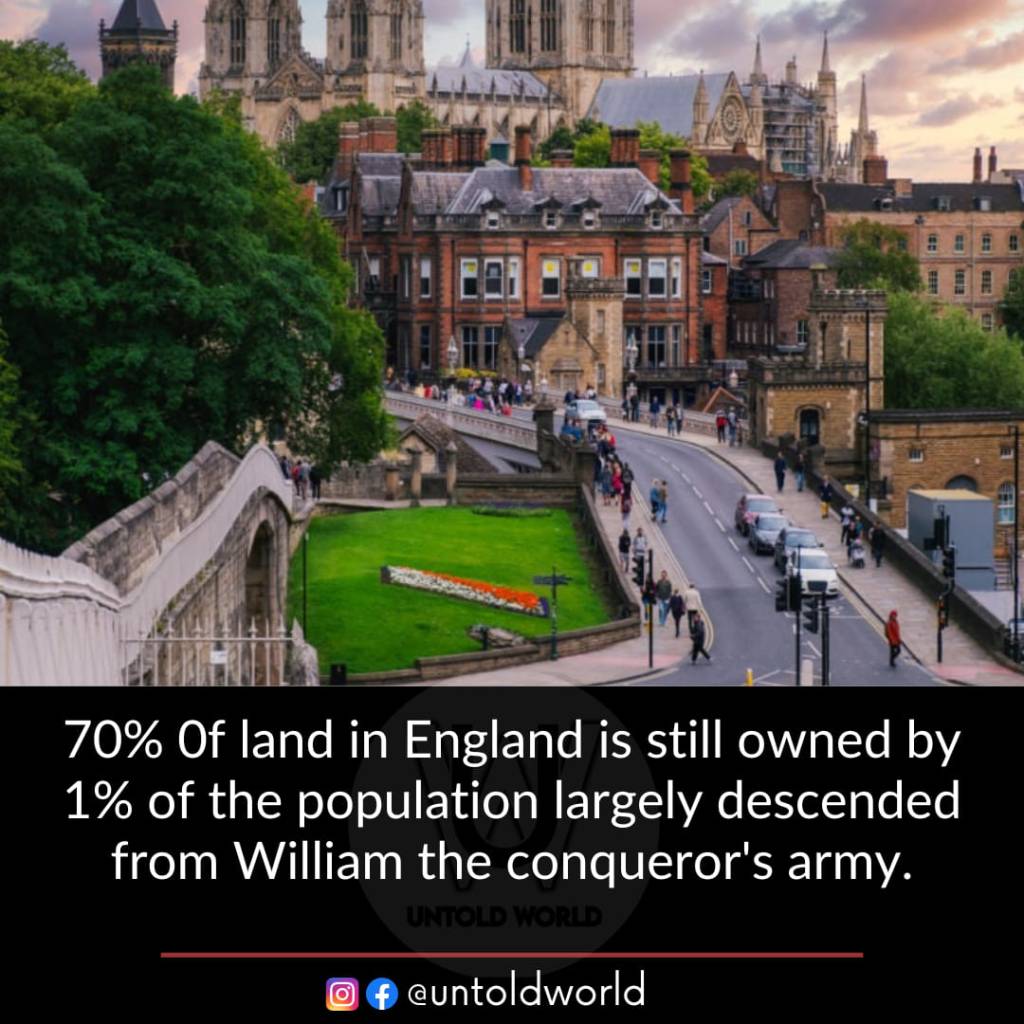
… and most of the other 30% belongs to people who inherited or bought from people who got rich by grabbing land in India and Africa and bleeding it of everything they could take.
The Book of Trespass reminds us the discomfort and guilt we feel when we ‘trespass’ are an illusion woven by those suffering from ownership insecurity. Their strategies are scary signs, fences, and everything from the Lord’s Prayer to the Downton Abbey dream. You know the one – you see a great, aristocratic wall that encloses some famous estate and, waving regally over the top of it, you see all those ancient trees. The sight of them suggests that the rich people are busy looking after bits of ‘real’ England, all woody and precious. In The Book of Trespass, author Nick Hayes calls those trees ‘curtains’. He says it’s amazing how many large estates have narrow strips of ‘real England’ trees round the edges, which they can claim to be usefully stewarding, and then acres and acres of ugly, money-making activity inside.
The book reminds us that although we all know the Enclosure Acts were terrible, we tend to forget they’ve continued right up to the present day. We tend to forget that the Greenham Common women, the Heathrow protestors and the Kinder Scout Trespass were continuations of the very same fury that drove all the previous generations’ commoners’ protests. And they still go on.
I bet you wouldn’t need to go more than half a mile from your home to find a bit of land that your cash-strapped council have up for sale. In the notices, they’ll say it’s being offered to Developers with Improvement Plans. What they are is plans to take the last scraps of public land away from the public, so they can sell little apartment-sized bits of it back to those who can afford it.
Little lords
An Englishman’s home is his castle, remember. No sooner have those poor saps bought their little bit of the ‘Improved’ area, they’ll be complaining that your kids, your dog or your parked car are nuisances that should be removed from their sight, or else complaining that we shouldn’t be letting refugees in because England is full. (Full? Remember all those thousands of hidden acres, wasting away to sterile dust under Forestry Commission confers, and rich people’s cash-crops?).
But don’t be angry with them – they can’t help it, they’re just stressed. And you know how it is, when people’s lives aren’t going right, they dream of winning the lottery, buying a big country pile and hiring a team of thugs (called gamekeepers, stewards or estate wardens) to keep the bastards (everyone else) away from them. People who don’t own any land yet don’t know that if they did, they’d still be stressed because they’d start suffering from ownership insecurity.
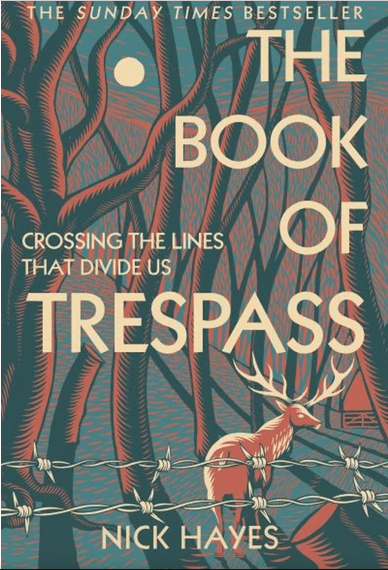
If you’re feeling like that, I suggest you read The Book of Trespass – regard it as therapy, a great remembering – and then get on out there, climb a wall somewhere and steal a bit of peace from a rich bastard – no no, I’m not advocating law-breaking. It’s just that such a large proportion of our country is privately owned that it’s almost inevitably going to happen by accident, sometimes, if you’re wild enough to just go for a walk.


Samoud
Sooner or later, all my blog posts – even the book reviews, tend to discover that they’re really about issues of race or sex or class and in particular, lately, about Palestine. Well so’s this one, because you know, it’s easy to think that the Palestinian people are almost unique in the world. Wave after wave of land-grabbers have come at them – the various empires, and then the Zionists, and most recently, US ‘Israelist’ settlers, and said “clear off, this is ours now” but the Palestinians have always hung on. Is it because of the olive trees? Is it because when you’re growing something that takes 40 years to start producing, then goes on doing so for hundreds and hundreds of years, when you do that, can you maybe hang on and imagine that you and your trees might still be hanging on when the latest wave of land-grabbers have tantrumed themselves to death and gone?

But the Palestinians are not unique. Admirable, but not unique. You can hear the howls of rage of dispossessed peoples all down the years of human history, ever since someone first came up with the idea of ‘owning’ land, and promptly went down with ownership insecurity. What’s different about Palestine is that the Palestinians have managed to bring the eternal crime into our living rooms and into our very hands via mobile phone videos and messages, and it has woken something that’s terrifying the propertied classes. It is the almighty howl of forcibly displaced people, echoing all down the centuries, and maybe for the first time, focusing on a single point.
It’s no mystery why all sane people want to stop the terrible, cruel crimes being committed against the Palestinian people but there’s more than that in the global movement for Palestine, something existential for all of us. The people belong to the land, and the land belongs to the people — all the land, all the people. From the river to the sea. Everywhere. We need to explain somehow, to the people of Israel, that we aren’t a threat to them, that the land also belongs to them, if they want to belong to it. It doesn’t become a problem until someone says “mine,” and starts building fences to stop other people using it.
Is it any wonder that millions upon millions all across the world have focused their attention on this struggle? We all feel, right down to our bones, that we have to win this battle for justice in Palestine. Is it any wonder that our big-money, big-property politicians are in such an abject panic about us feeling this way, or that they have to keep spouting desperate, divisive nonsense, because they daren’t tell us what it is they fear?
********************
Dear Reader,
Times are hard, and so the articles on this site are freely available but if you are able to support my work by making a donation, I am very grateful.
Cheers,
Kay
********************
 Kay Green
5 responses to “Trespassers Will: a great, long, monster blog-post posing as a book review”
Many thanks for recommending The Book of Trespass, I am now eagerly awaiting it’s delivery. It has taken me the vast majority of my 73 years to realise that we are nature and indivisible from it, along with all the rest of the natural world. Yet, we are dispossessed not just of the knowledge of who and what we are, we are dispossessed of our birthright and are landless and we’re educated to remain ignorant of that dispossession. I’ll include a link to my latest blog, in which I’m attempting to address the brainwashing that dates back to the Norman invasion, not least, politically and who actually runs the country. https://conspiracy-of-kindness.com/2024/03/13/we-the-people/
LikeLike
Thank you! And – yes, I have that one of yours bookmarked, and look forward to it.
LikeLike
Oh dear, I forgot to mention, that was such a brilliant and inspiring read and has come at a critical time on my life. Thank you.
LikeLike
Brilliant – as ever. Then I discover the Book of Trespass unread in my Audible library. Phillipa Gregory’s Normal Women is proving a fascinating read as well.
Keep going, Kay.
LikeLike
Thank you, I’ll do my best (just added Normal Woman to my reading list!
LikeLike