
A cry central to the history and spirit of Hastings — I wonder if an understanding of that will outlast the determination of commercial developers to fill the town with those who can afford affordable (and even unaffordable) housing.
The Stade and all who sail in her

It’s a favourite twist in Hastings history, the way we’ve always had this beach-based fleet – fishermen of course, what else could they be? It’s just that there were periods of time when they were heroic privateers and periods of time when they were bastardy pirates, and long periods of time when they were brave, ocean-going fishermen, and, when I was growing up, due to recession and the time it took for our politicians to address EU rules that favoured larger boats, they sat around on the beach amongst a bunch of dilapidated, unused boats, or ran little businesses from their huts and netshops.
In short, a skim through the history books demonstrates that what the denizens of The Stade were doing, and whether it was legal, always depended on what the short term interests of the politicians of the day were.
Anyway, that’s the Hastings fishing fleet, and we love them. This is the modern, tourist-friendly Hastings’ Pirate Day.
Yesterday evening I went out for a quiet supper and a drink with friends which … got less quiet, and a lot more colourful due to having to walk home through a mob of half-cut, frilled, kerchiefed, much-feathered and tasselled citizens taking turns to leap out at each other and go “Haarrrr!”
That is because Hastings either has got and is defending, or is aiming to reclaim (one of those two is always the case), the world record for the size of the crowd of its citizens who are willing to go into town dressed as pirates (and later, after a few pub-hours, leap out at each other and go “Haarrr!”)

You would have thought swinging around town in a drunken state, carrying things that are a passable imitation of lethal weapons, and leaping out at people and going “Haarrr!” might count as disturbing the peace, threatening behaviour or even assault but of course it doesn’t, because the police know they don’t mean anything by it.
The trouble is, it doesn’t feel the same as it has in previous years because it got me thinking about how, in the last few weeks, friends and comrades of mine have been arrested for brandishing, waving and shouting, things far less aggressive and dangerous than the average pirate’s festival-day repertoire.
When I got home, I had a look through my badges and posters from the Palestine campaign, and from the women’s rights campaign before that, and had a think about the things people were, and are now, getting arrested for.

Of course, we know why none of our Pirates’ Day revellers get arrested – the police know they don’t mean any harm – but we do get a bit confused about our heritage when it comes to pirates – or are they smugglers – or are they warrior-heroes of the high seas, or suspiciously ill-defined traders sitting around on the beach — because you see, the difference between those things, in any given period in our history rather depended on whether our government had currently put us on a war footing against France, or any of the other countries whose shipping made use of what we please ourselves to call ‘the English Channel’.
Perspectives
Which leaves me wondering a bit about some of these other sometimes-crimes I’ve seen people arrested for in recent years, most recently chalking on a path…
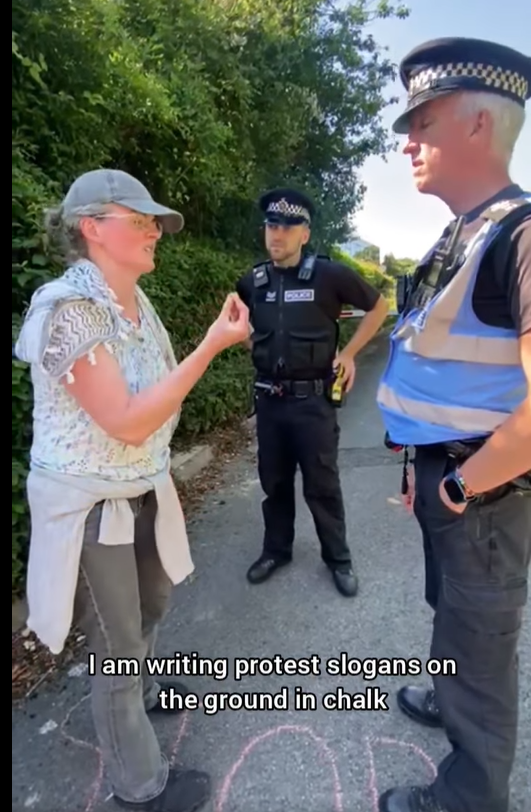
…and holding up a copy of Private Eye.

I spent quite a lot of words a few days before a recent proscription trying to work out what the government interest was in a lot of these things – piracy, for example – I wrote to my MP, asking if the authorities had made a proper response to all those people who reported an act of piracy when the Madleen was boarded in international waters by Israeli forces, and its crew abducted. I will do so again if and when the Handala is attacked but my MP didn’t answer my question then, and I doubt she will now, and I suspect this is because most MPs have worked out that neither Israel nor our own government could address any of this without laying bare evidence of their own war crimes.

So have laws always been made to protect governments and their business interests from us, the people? I’m currently reading The Mechanic and the Luddite by Jathan Sadowski and, amongst other very good points the book makes is that the Luddites have been seriously slandered both by governments then and now, and by the history books.
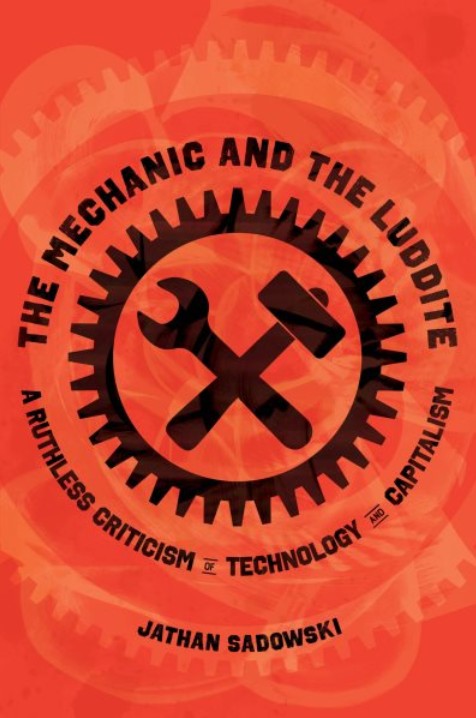
They weren’t technophobes, blindly trying to ‘stop progress’. The machines they broke often were not new inventions. As a movement, they staged intelligently targeted actions. They specifically attacked machines belonging to industrialists who had the audacity to sack skilled workers, then try to re-hire them at starvation wages as machine operators.
In UK law, the fact that you were trying to prevent a greater crime can be sufficient defence against a charge such as criminal damage. The only way the government could prevent activists claiming this defence would be to deny them the right to a jury or a freely spoken defence in court, or else to accuse their organization of a state-level threat – terrorism or treason – and proscribe them.
The reason I’m telling you this now is that when Ned Ludd, a weaver’s apprentice, smashed two knitting machines, it was probably an unpremeditated fit of rage, and the crime he committed was plain, ordinary criminal damage but, when the movement that was named after him worked out the factory class’s weak point, and set about such very well focused attacks on factories to prevent the marginalization and impoverishment of whole communities, the owners accused them of standing in the way of ‘progress’, and the government responded — the crime, they said, was not criminal damage, but treason. So we can see that when the people find an effective weapon against a criminal class (such as the military-industrial complex) governments crank up the laws so they can hit them hard.
Women’s rights and genocide
So if I take the cases I was thinking about when I looked through my badge collection, I’m guessing that the government went through a phase when it encouraged the police to go after women who were flagging up sex-based law because the politicians at that time (that is, before the judicial review that brought us clarity) feared that their institutions (corporate donors and government agencies) had been breaking the law (they had).
The same may be true of the recent proscription, and the ramping up of police responses to anti-genocide campaigners generally. I think it’s very likely our government has clocked up some crimes – at the very least, harbouring criminals – such as when Israeli politicians and military come to the UK, but it’s also possible that politicians are in the business of protecting their military-industrial donors and supporters (those planes that got spray-painted weren’t RAF property — they belonged to a corporation profiting from the government’s enthusiastic militarism).
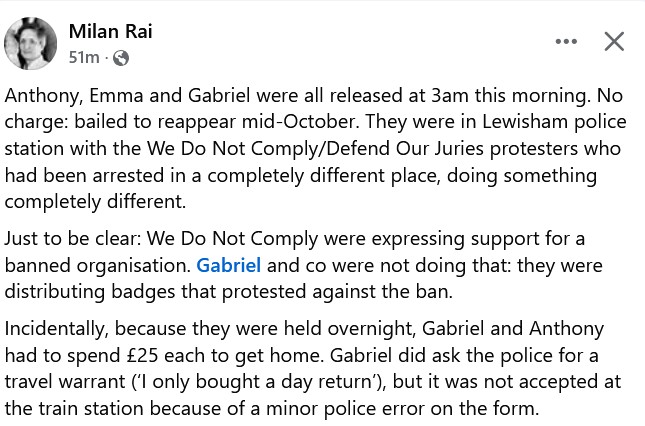
Have a browse around some recent social media posts, and decide for yourself which, just now, are the big crimes, and which the smaller crimes committed in an attempt to address the big ones.


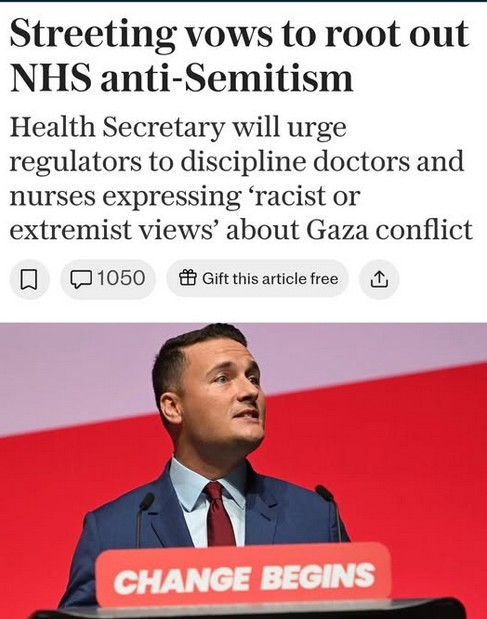


We have to do better than this
Terrible, terrible things are happening. Our own citizens are being starved of funds and services they need when they are elderly or disabled, our government and industries are implicated in all kinds of violence across the world, up to and including genocide in Palestine, and all the while, the climate crisis is tick, tick, ticking to the point where we simply won’t be able to save ourselves.
It’s time everyone woke up to the fact that we need a government that works for us, not one that works for politicians and their business interests. Once enough of us know that, we can stand up together and create something better. It’s not going to be easy though. To understand the scale of the problem, check out the definition of ‘radical nationalism’ in post linked below.

********************
Dear Reader,
Times are hard, and so the articles on this site are freely available but if you are able to support my work by making a donation, I am very grateful.
You can make one-off or monthly payments by BACS to Mrs K Green, Sort: 07 01 16, Acct No: 43287058, Reference: blog
Or via Paypal…
Click here to donate via Paypal
Another great way to support this, and other independent blogs you read, is liking and sharing on social media, signing up for email updates, or by emailing a link to friends.
Cheers,
Kay
********************
 Kay Green