[Note to Hastings: I am three blogs behind myself, because I was stuck on this book review. On the one hand, there’s the angry, bitter, political version, reflecting the rage and dread we’re all feeling; on the other, a positive review, full of admiration and falling over itself to tell everything I learned — because I learned some beautiful things, some things that just might help. Well, I finally figured it out – I’ll do them both at once.]
Let’s just remind ourselves before I start, of the deprivation and misery of those who had no money or space of their own during COVID, and of the key workers, particularly Black and Asian workers, who died whilst trying to keep the world turning for us, whilst those with sit-down jobs, talking and writing jobs, got to stay home and get things they needed sent to them, and those in the middle (like me) learned how nice it is when everything stops, whilst watching our little businesses disappear.
Whatever happened to the ‘healthier, more equitable, and more prosperous future’ the great and the good were planning for after COVID?
The blazing review
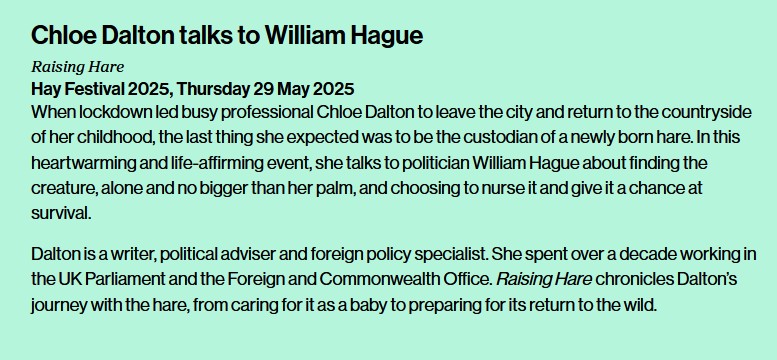
Chloe Dalton, as anyone who went to Hay Festival, or was reading the Sunday Times last summer, will know, Spent COVID lockdown in the converted barn she happens to own, and discovered an abandoned, baby hare. Chloe was a SPAD, and poking around a bit, I was not surprised to find her name attached to William Hague (that is William Jefferson, Baron Hague of Richmond) as it was he who interviewed her at Hay Festival after the book was written. Back then, she was earning around five times what I, or come to that, most of the ordinary people in this country, earn. She was doing things like “channelling pure Hague” into his speeches, according to an Evening Standard article about London’s ‘power rangers’.
One wonders what Hague would have sounded like without a speech writer who could make him sound like him? Maybe he would have sounded more like a person who colluded with the destruction of Libya and Syria, or a person who betrayed Julian Assange, or someone who joined David Cameron and company getting fat on the eternal austerity UK politicians swear by?
Anyway, she found this baby hare, and tried to help it survive, and got fascinated and, having been slowed down by lockdown, decided to stay slowed-down, do her SPADDing remotely, learn all about hares and by extension, the British countryside. She wrote a book about it. Now, having been involved in small press and book trading generally, I know what a long and lonely battle prospective authors have, trying to nail down the first book and get someone in the trade to look at it – but what do I see in the acknowledgements to SPADDy Chloe’s book? Thanks to her agent who, “made me take my coat off as I walked out at the end of a meeting and tell her ‘now’ about the story I wanted to write ‘one day’.”
The next thanks go to the editors at her publisher’s who helped her write the book!
Wow. Just watch one of the authors I tried to give a leg-up to jumping the barriers at the London Book Fair, fighting their way up the forbidden escalator, grabbing an agent and saying “I raised a baby hare and learned a lot – will you get a publisher’s in-house editors to help me write a book about it?”
Depends on the circles you move in really, doesn’t it. Still, if she was at home raising hare, then at home writing the book, we can at least assume she wasn’t in London whooping it up at any of Boris Johnson’s super-spreader events. We can only guess who thought up Rishi Sunak’s ‘eat out to help out’ line though – it certainly wasn’t any of the government’s scientific advisors.
Okay, I’ve calmed down now.
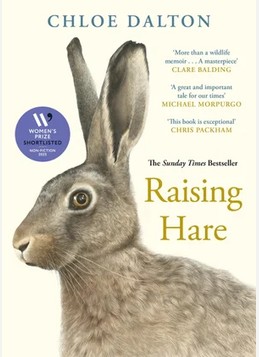
Raising Hare really is a tremendous book. It grabs you from the start so that before you know where you are, you’re engrossed in the fine details of what a young hare looks like and what it does all day, and trying to guess why it does those things, you’re gazing through those windows into long ago worlds that snippets of mythology and poetry about hares can open, then you’re devouring a critique of the hunting laws in the UK, particularly with regard to how unfair they are to hares.
Dalton’s description of her learning journey is as much an education for the reader as it is for her, as she acts on her determination not to turn the animal into a pet, but rather to learn how hares are supposed to live and facilitate that; and that leads her into investigations of all the ways wildlife is now challenged by modern countryside management, including by opportunist attempts at ‘sustainability’, and that informs her research into how things should be, if the animals and plants we ultimately depend upon are to have a chance.
I emerged from the book quiet and thoughtful, mentally listing books I need to re-read now – like the Ministry for the Future for example…

… and looking through my reverie into where we sit now, traumatised from watching our government facilitate Israel’s destruction of a whole country — people, infrastructure and even landscape and, having been allowed to get away with that, starting work on the destruction of another. We are traumatised by that and now, exhausted by trying to do what we have to do through a heatwave that’s set off debates about climate crisis everywhere, it seems, except in the government we just can’t seem to shake off.
I assume those SPADDy people are still telling politicians that if they go on holding their nerve, acting as though genocide is perfectly normal and the worst consequences of climate crisis are years away, everything will be alright.
It won’t bloody well be alright for hares, will it!
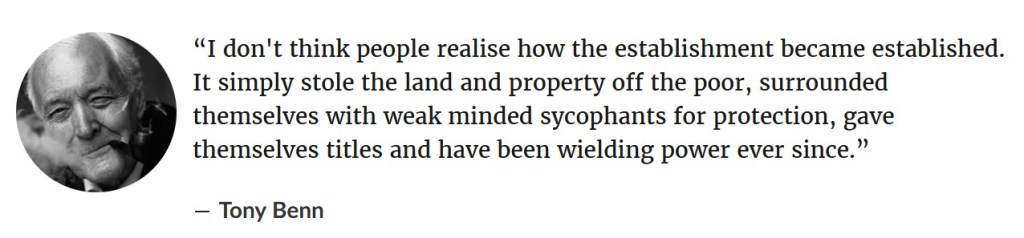
But those aristocrats, those landowners, with career-paths laid out for their children, they know how to keep two lives running, and keep the cognitive dissonance at bay – they’ve been doing it ever since… ever since… well, ever since they stole the land…
I wonder if it’s occurred to Chloe Dalton, since the transformation of her life that started with a baby hare, that if the world were organised so that everyone had the land and resources necessary to be able to just stop their lives and do some studying when an unexpected inspiration came their way – if everyone had that much leisure to live their own lives and do their own learning, then lots of people would stand a chance of producing something as beautiful as this book. Perhaps then, between us, we’d truly understand what we need to know to stop the juggernaut of destruction. Perhaps we as a society would have the backbone to stop a genocide in its tracks, and the strength to turn our extractive society around and give hares, and the rest of nature, a chance to save us.
But first, we’d have to get the land back off them, and re-establish commons-culture.
Do read Raising Hare. It’s a great book. It’s not Dalton’s fault she was raised to live easy off the backs of suffering people on a dying planet, and she’s been saying the experience made her a better person so there we go — well done, hare!
Oh and by the way, one of the things Chloe worked out along the way is that mother hares do not carelessly ‘abandon’ their young.
Phew. Right. Now I’ll make a start on the blog posts my friends in Hastings think I should have been writing this week….
********************
Dear Reader,
Times are hard, and so the articles on this site are freely available but if you are able to support my work by making a donation, I am very grateful.
You can make one-off or monthly payments by BACS to Mrs K Green, Sort: 07 01 16, Acct No: 43287058, Reference: blog
Or via Paypal…
Click here to donate via Paypal
Another great way to support this, and other independent blogs you read, is liking and sharing on social media, signing up for email updates, or by emailing a link to friends.
Cheers,
Kay
********************

