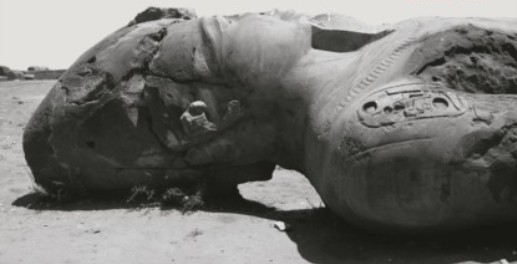
Did you know that the average lifespan of a state is 326 years? What’s even more exciting is that mega-states – hierarchical organisations of control that cover more than one logical, geographic area – only last an average of 155 years.
Did you know that the overarching reason for states’ extreme obsession with secrecy is that if their own people knew what they were doing, we’d be moved to stop them doing it.
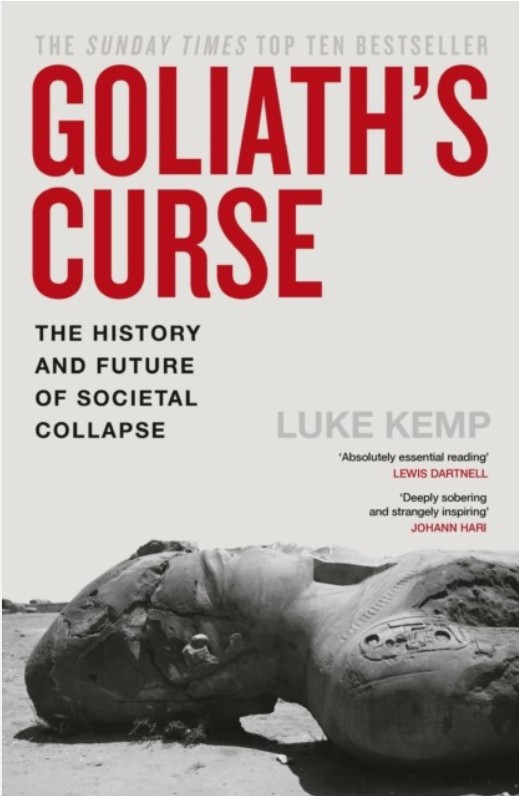
There are so many books about gloom and destruction lately – for a very good reason – and yes, Luke Kemp’s book Goliath’s Curse is in many ways one of them but, having been talked into reading it, I am really enjoying it. Why? Because whilst it reminds us what a bad idea hierarchical states are, it also takes a good look at just how fragile they are.
Unlike apocalyptic books that have gone before, Kemp’s book is not a study of two or three states and how they failed, it’s a survey, wide-ranging in time and space, of system collapses. The subtitle is ‘the history and future of societal collapse’. In the introduction, Kemp defines a Goliath as ‘a collection of dominance hierarchies organized primarily through authority and violence’. He points out that people talk about empires, states and civilisations failing, and that the writers of history almost always call these collapses catastrophes, but also that there’s a less-often-recorded side to it. The collapse of states and dynasties can be abrupt and unforeseen, and will be remembered as ‘the end of the world’ by those who had comfortable seats in them – but peoples and cultures appear to have far more resilience than states do, and despite the undoubted chaos and trauma along the way, those collapses often bring a welcome new beginning.
What are states for?
Right now, looking at the US/UK/EU – ‘the first world?’, some of us are beginning to think the current global Goliath is actually Israel but I don’t know – I think Israel might be a grand vizier who’s about to be thrown to the lions by the real king but whatever. Looking at what ‘our lot’ are doing to Western Asia, to Africa and South America; to the poor, the weak and the sick in our own societies, and even to our very global ecosystem, you can see why for a lot of people, a few decades of chaos and trauma would be a price worth paying to see Goliath fall.
That’s not sheer fantasy. Those ancient centres of power, control and profligate human sacrifice that left only pyramids and sculpted mounds as evidence of their passing appear to have died of their populations saying ‘sod this’ and leaving. There’s not enough easily accessible space for the victims of modern Goliaths to do that – that’s why we have a ‘refugee problem’ but, one of the examples of collapse Kemp looks at is the Barre government of Somalia (a US backed regime – no surprises there). When Barre fell, deaths in childbirth and child mortality dropped dramatically, extreme poverty fell by 20 percent and all the indicators of welfare and development went up – despite the chaos and civil war that ensued, a decade later, Somalis were better off without a functioning state.
“But we aren’t like them…”
Historians are often asked whether studying the fate of ancient states can help us understand and predict the fate of our own but Kemp’s book ranges over time and finds common factors. He writes: ‘In each of the key dimensions of collapse – energy capture, population density and hierarchy – the modern world is simply an intensification of the past.’ However, he knows the modern system well enough to look not just at state structures as they present themselves, but also at the web of government, corporate and tech worlds – did you know that ‘every resources minister in the Australian government since 2001 who has retired from government has then taken a position in mining, consultancy or the fossil fuel industry’?
He also takes a long, hard look at what many governments present as technological ‘solutions’ to climate and biodiversity crises – and finds them wanting. They are excuses, covers, ways of looking like you’re dealing with things. In short, they are treating the symptoms, and they do so to help hide the fact that our actual disease is hierarchical, extractive states.
But here’s the main reason I’m writing this review. Being a politically and/or environmentally aware activist is a deadly sober business lately and I believe this book is a vital addition to your armoury but you know what? – reading this book is an absolute pleasure. I’ve been glued to it, turning pages eagerly the way a whodunnit addict does. What I’ve been doing is looking for – and finding – loose threads in these Goliaths with their feet on our necks. Kemp’s got me thinking about how we go about giving those loose threads a good, hard tug, and how we might keep on doing that until Goliath falls.
Chaos, panic and violence?
Am I being irresponsible, wishing for ‘anarchy’? I don’t think so – well, certainly not untypically so. Right back in the 1950s, psychologist Eric Berne was studying ‘the big kill’, the discovery that most people were walking around dreaming about the catastrophic fall of the society they lived in – and those dreams weren’t nightmares. As a very famous 20th century influencer once sang, ‘I’ll let you be in my dreams if I can be in yours.’

I’ll finish by going back to Kemp’s Chapter One, which has the subheading Collapsing Back into Human Nature. He traces the idea that the collapse of the state leads to panic and violence to Hobbs, and then on and on, back to the most ancient written records we have, all telling the stories of peoples anxiously seeking and installing kings – but: he finds that those records were almost exclusively written by and for the people at the top of the heap, the people in whose interests it was to maintain belief in the ‘social contract’ – the idea that people who, undirected, would be a bunch of maddened murderers, agree to give power and control to the boss to save themselves from their nasty, brutish selves.
Well the bosses would say that, wouldn’t they. Kemp’s investigations tell quite a different story – as does the recent example of the people of Gaza. With the assistance of the US and the UK, Israel threw everything at them, and is still doing so. Did any people anywhere ever suffer such a concentrated, relentless battering? And yet, Goliath had to actively smuggle in wave after wave of thugs, guns and hard drugs before they even began to break down the social resilience of those most unfortunate of people.
Stand up for the Palestinians any way you can think of, and for the peoples currently under the cosh in Africa and South America, and the hard-pressed wherever you are, but do not despair. Humans are resilient and endlessly resourceful, and Goliaths do fall – or more often, get felled.
Keep searching for those loose threads, and – p-u-u-u-u-ll!
Happy reading!
********************
Dear Reader,
Times are hard, and so the articles on this site are freely available but if you are able to support my work by making a donation, I am very grateful.
You can make one-off or monthly payments by BACS to Mrs K Green, Sort: 07 01 16, Acct No: 43287058, Reference: blog
Or via Paypal…
Click here to donate via Paypal
Another great way to support this, and other independent blogs you read, is liking and sharing on social media, signing up for email updates, or by emailing a link to friends.
Cheers,
Kay
********************

