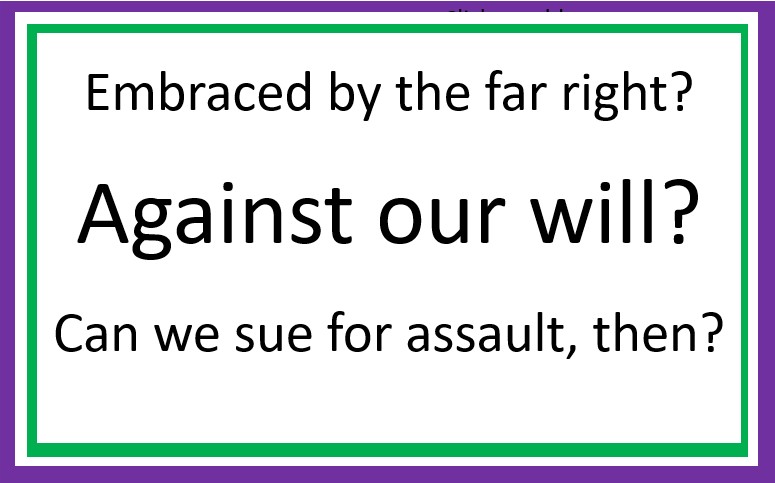
Some thoughts on that far-right bookshop article’s bumpy journey round the world
It is certainly a stereotype to say that a meeting of women is an argument, a stereotype that has a lot of evidence to keep it going. To my mind, it’s not really a criticism – I think it’s because women’s gatherings tend to be more egalitarian, and much less likely to have a rule book, so decisions are made by consensus in happy times, and by argument the rest of the time.
My partner has another theory. He thinks groups of men go to a lot of bother to avoid arguments because in our society at least (and here comes another stereotype that’s not short of evidence) men are much closer to that line where an argument becomes a physical fight, so they try harder than women do to lay down rules, and keep within limits.
The problem for women is that when times are hard and society polarized and febrile, arguments can be so vicious you feel like you’ve been thumped.
The problem for feminism, all down history, is that when you’re trying to represent/speak for/understand a group that makes up over half the population of the world, there’s plenty of scope for disagreement.
More in common, but also…
Everyone knows that the Pankhursts were a family of suffragettes — how many people know, though, that between them, Emmeline, Christabel, Sylvia and Adela encompassed a broad spectrum of Britain’s political and cultural options of their era? For example, when Emmeline made it clear she didn’t want to head a working class movement — that she thought it far better that people like her acted on behalf of lower class women, Sylvia — well, Sylvia probably didn’t even hear that her mother had said that, because she would have been down in the East End, helping to run community kitchens, or organizing delegations of factory women to join protests or lobby parliament.
But they were all famous suffragettes, so they were all the same, right?
No.
For another example, have a glance at the BBC guidelines on gender/sex and gay/lesbian. It says: “…Where possible, however, initials should be avoided and care is needed with the use of umbrella terms. The issues affecting lesbian, gay, bisexual and transgender people can be very different…” — and yet journalists cheerfully write about the opinions of ‘the LGBT community’ all the time, because they’re all the same, right?
No.
I’m told that back in the ’90s, when Ruth Hunt decided Stonewall was going to add ‘T’ to its former ‘LGB’ remit, it was Julie Bindel who went to her and pointed out that whilst doing so would give Stonewall a whole new funding stream, it would also be attempting to represent groups whose interests did not align particularly well.
So there are two ENORMOUS opportunities for conflict amongst feminists right there. Nevertheless, when (around ten years ago I think) Stonewall recommended to a parliamentary committee that the best thing they could do for trans people was to scrap the sex exception in the Equality Act (the clause that allows for single-sex services and spaces) women of all kinds, from all parts of the political spectrum, and a similarly broad mix of gay and lesbian people, came together to say, ‘hang on a minute – the funding and the evidence base for most of our groups, services and legal rights depend on the sex exception. Can we talk about this?’
In response, Stonewall went, ‘Terfs! Bigots! Far right infiltrators!’
Back in 2020, I teamed up with a Green Party woman to run a workshop for women addressing the sex-based rights issue in their political parties. Women attended from every party from the Communists to the Tories — and it didn’t turn into a bun-fight…
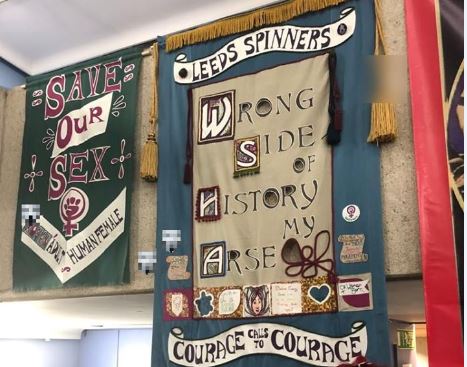
And where are we now?
The left and right of ‘the GC movement’ most definitely could not co-operate now as they could then, and quite honestly, they shouldn’t. Here’s why…
I remain convinced there are ways of making life easier for trans people that don’t involve sabotaging the Equality Act but, judging by the howls and the fury that followed the now infamous Supreme Court judgement reconfirming sex-based law, the people we now think of as ‘trans activists’ or ‘trans allies’ do not agree. And they so love to call us ‘the far right’ that many women have dropped out of the sex-based rights movement because they got fed up of people screaming ‘fascist!’ at them.
That has left us with a relatively right wing ‘gender critical’ (GC) movement, and a relatively small number of feminist, socialist and gay and lesbian activists still sturdy enough to stand up for the sex-based provisions of the Equality Act, despite getting shouted at from both sides of the political field. Meanwhile, the entire political scene has become more polarised, more racist and more rage-fuelled.
It took me about 30 seconds on soc media to find an example to post…
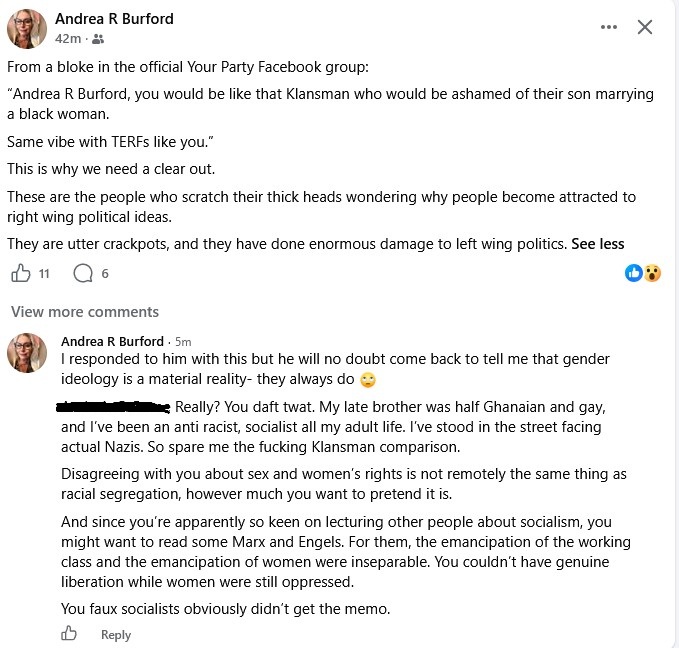
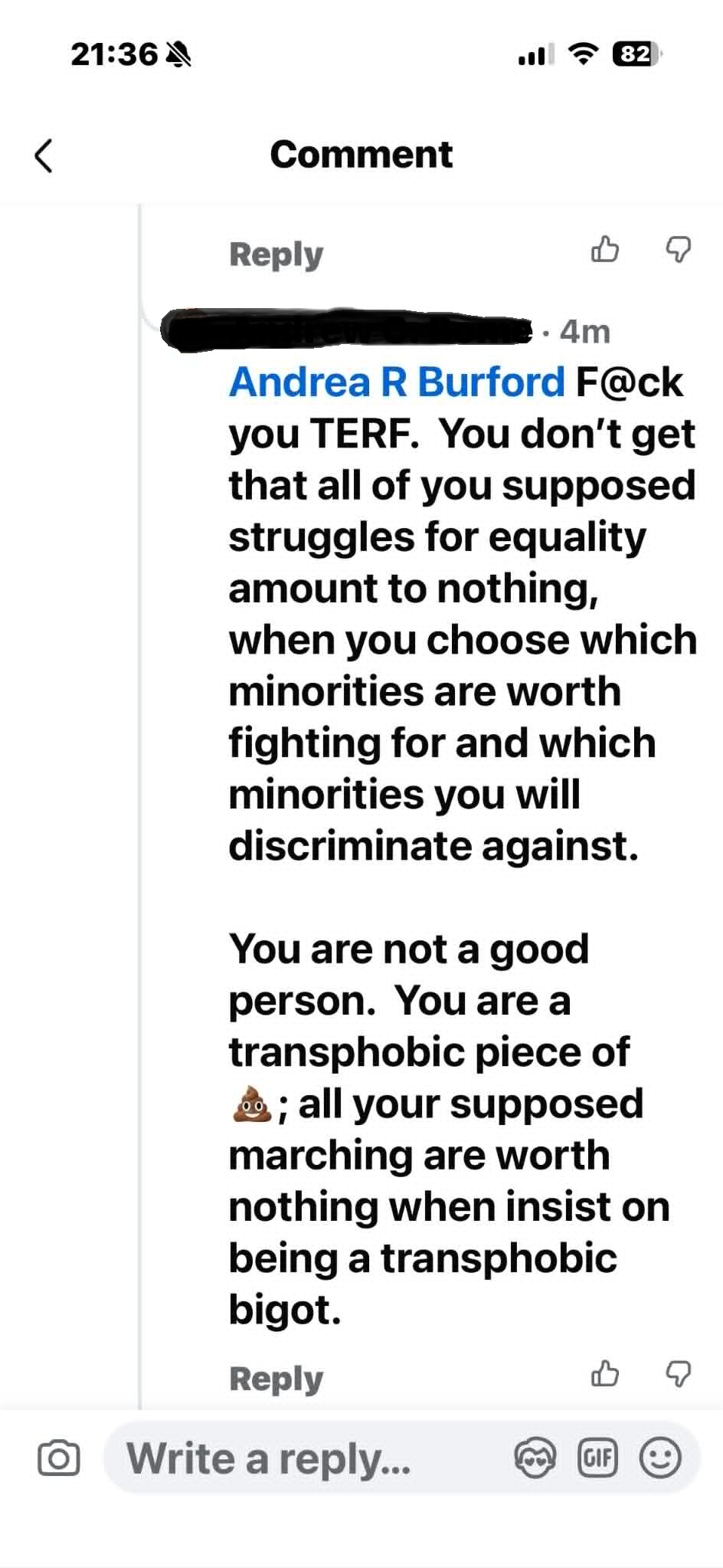
Your Party — is that how a socialist should talk to a feminist? And what do we mean now, when we talk about the far right? There doesn’t appear to be much agreement on that, and that is where Simon Edge’s story of the far-right bookshop in Suffolk comes in.
Right and far right
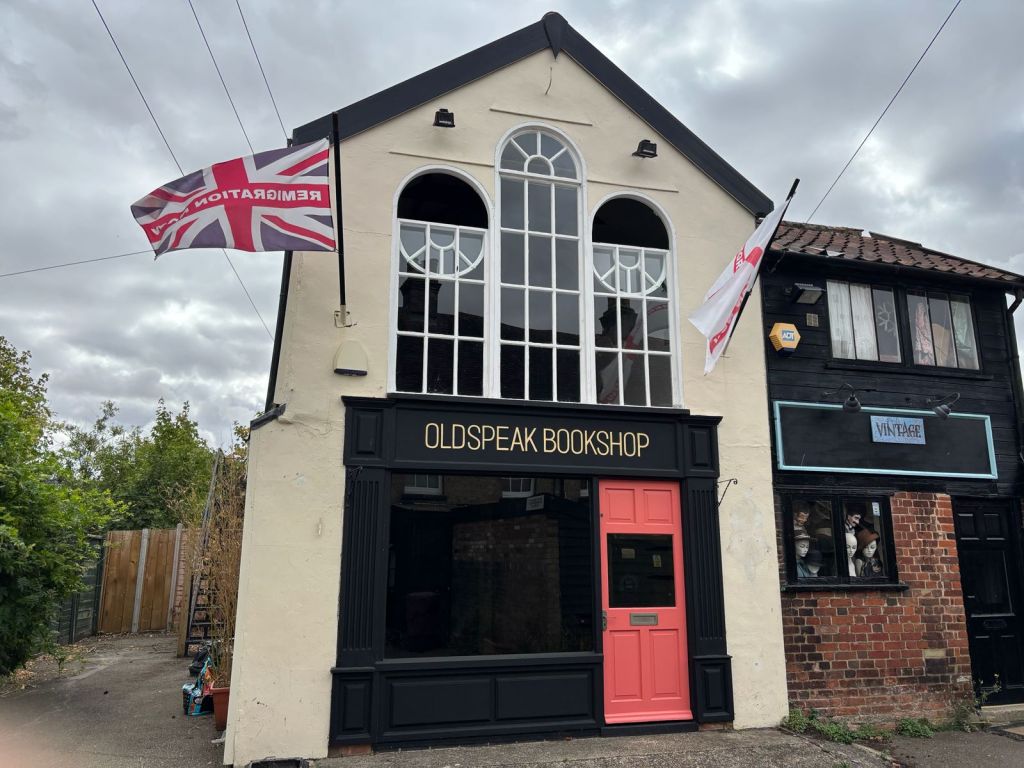
I don’t do TwitX, but I was told the reception his article got there went something like this: “Outrageous to call Oldspeak far right, and anyway what’s wrong with being far right, and anyway we never supported Oldspeak, and anyway we’ll support it if we want to, and how dare you call us far right, and of course we hate Muslims.”
Obviously, the above was a tongue-in-cheek summary of others’ words, but around social media lately, I’m seeing a lot of women — many of them ex Labour Party, expressing views like that. How did that happen? Are they believing what they read in what is now a very right-wing, very dishonest media?
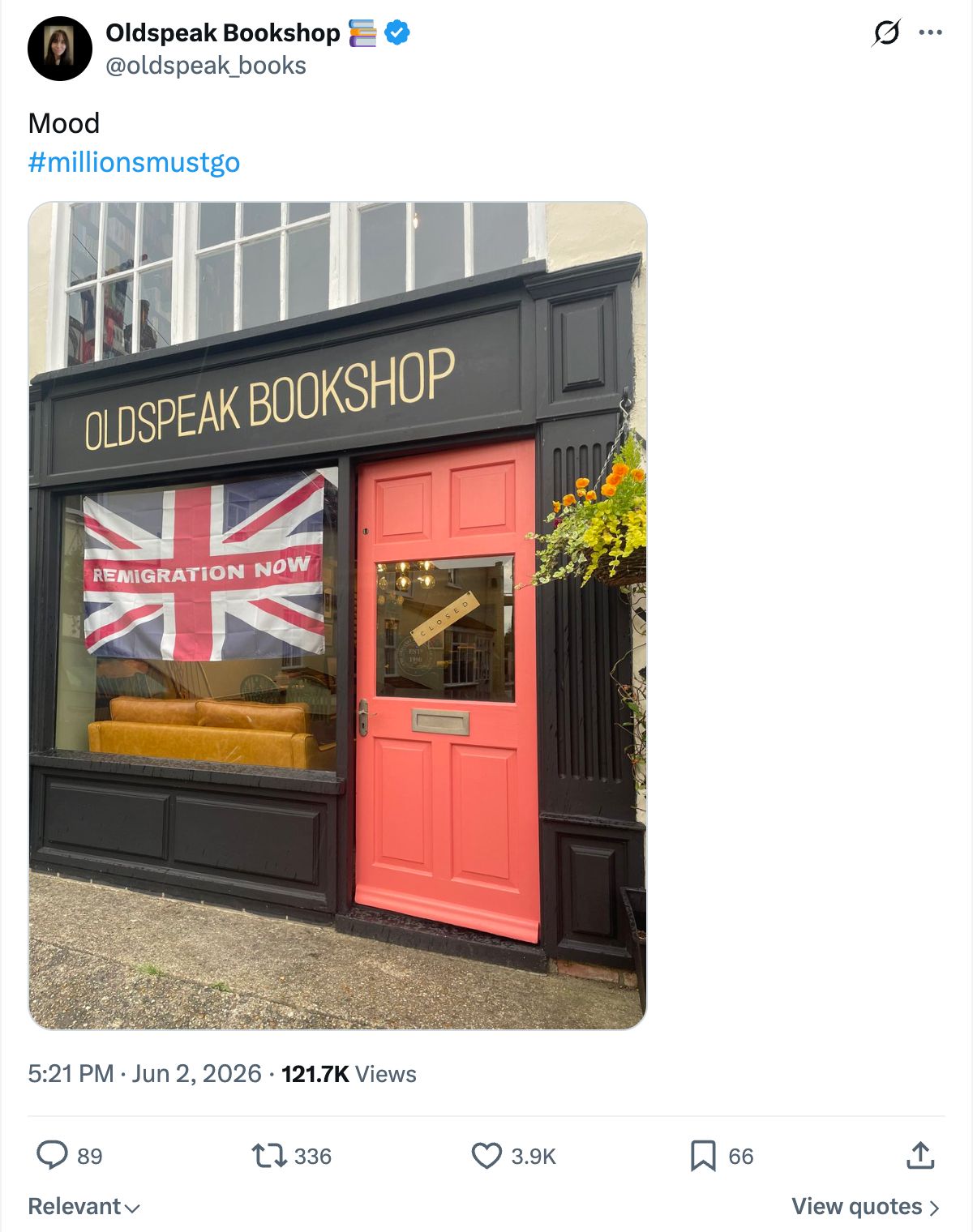
Here’s a direct quote from somewhere so far right I can barely see it: the owner of that far-right bookshop apparently experienced hostility from the locals because she “sells the wrong kind of books to the wrong sort of people who, like her, have the wrong opinions. She hung the Union and St. George’s Cross flags outside her shop.” That’s from an article in the Washington Examiner, that picked up on Simon’s blog.
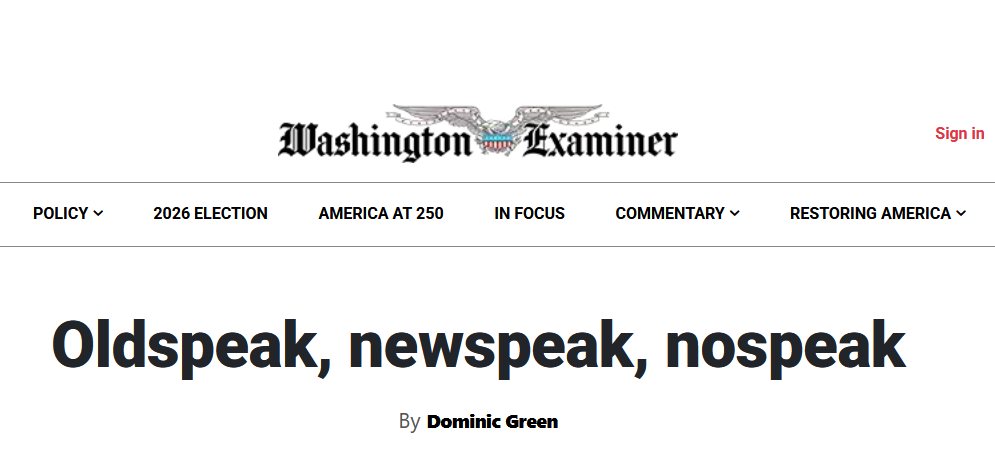
Every element of that description of Oldspeak’s proprietor is so utterly misleading I can see why some Examiner readers might feel their extreme right-wing views are quite civilized. The bit that really grabbed us was the bit about the flags. Does this look like our national flag to you?
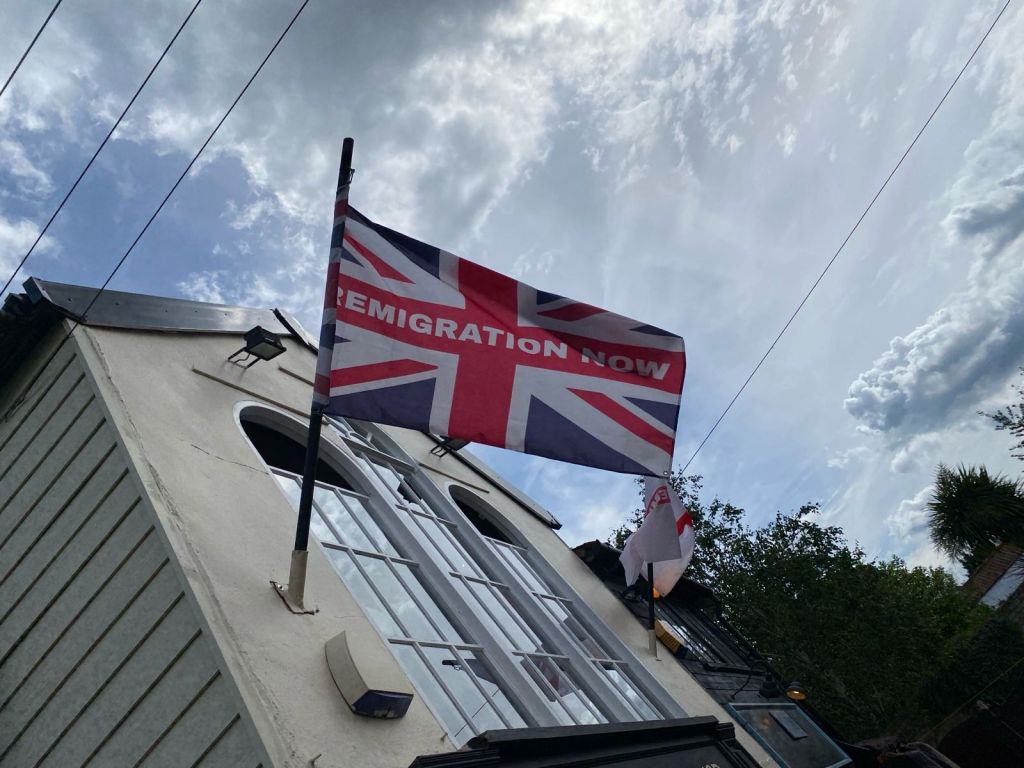
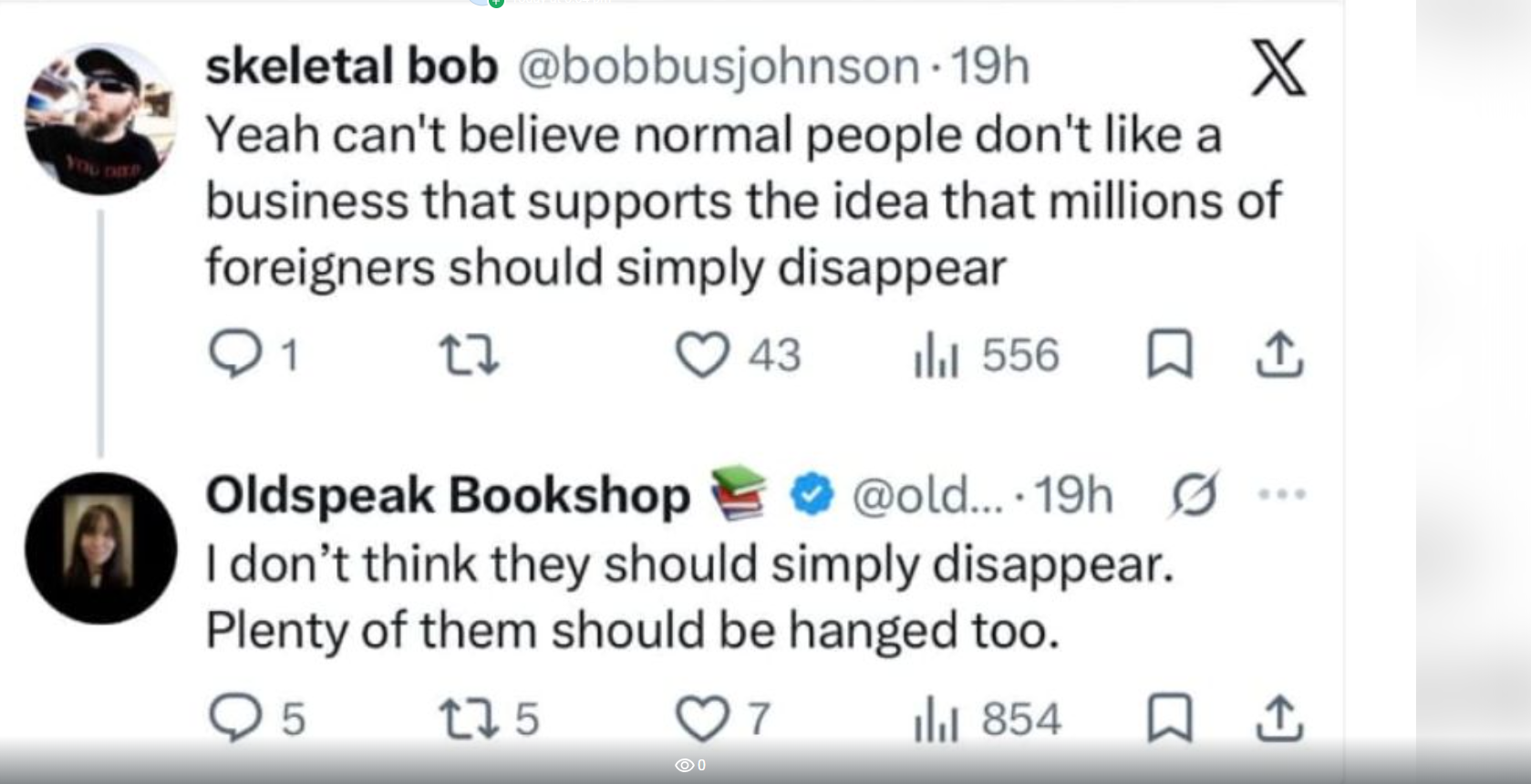
… and how would you feel about your local bookshop owner posting a pic like that on TwitX with captions like ‘remigration’ now, ‘#millionsmustgo’ and comments about how many ‘should be hanged’?
Back in 2020, when I did that cross-party workshop for women, the ‘far right’ end of the room was a couple of rather plummy sounding women from the Conservative Party, which was considerably more civilized back then than it’s been since David Cameron and Boris Johnson got hold of it. The far left were some equally affable academics from the Communist Party. It was a world away from the political range and mood we have now.
I’d say the dash to the right (and into the gutter) instigated by the likes of Boris Johnson, Nigel Farage and the Mandelson/Epstein crew ripped up what for a while seemed like a united movement for women’s rights.
In short, some of us got off the party-political train, whilst people whose primary allegiance is to a party or a flag went on cheerfully following their leaders into reactionary racism and other extreme, destructive ideas.
However
There’s also this crazy idea that left wing and right wing ‘gender critical’ people share the same opinion. They do not. When Simon’s blog was picked up by a writer for the TLS, I found myself reading yet another article by someone who I suppose is a professional journalist but one who hasn’t bothered to find out what the issues around gender ideology really are. He merely quips that many ‘gender critical types … end up embracing such [far right] positions, or being embraced against their will.’

I no longer use the term ‘gender critical’ if I can avoid it – it has been attached to some crazy ideas – the original meaning was pretty much the standard position of second wave feminism ie, gender is not innate, it’s imposed. It’s a sexist form of oppression, and should be discarded so that boys and girls, women and men, can choose the sports, the clothes and the lifestyles they want according to their characters rather than imposed conventions. That is why a lot of feminists don’t take kindly to men saying they ‘feel like a woman’ when they mean they want to wear court shoes and make up and flirt a lot.
For those at the back: left wing and right wing ‘gender criticals’ do not share the same beliefs at all. Holding a view that equates to second wave feminism does not turn one into a fascist, nor does it endear one to right wing commentators.
However, right-wingers who call themselves ‘gender critical’ think everyone should conform to sex-stereotypes and perform traditional sex roles. Their stance is actually closer to trans ideology (that says ‘if he likes dressing up, he’s probably a girl’ and ‘if she won’t behave like a girl, maybe she should have a ‘sex change’.)
Here’s a handy diagram for journalists to stick up by their desks.

And here’s a comprehension test: which of the stances described in the diagram do you think are ‘anti-trans’? And finally, to put some of that together, remember I called this article ‘Sylvia not Emmeline’? If you’ve been a part of the women’s rights movement in recent years, you probably recognise the expression. Sylvia Pankhurst was a feminist activist who gave no quarter. She was also a revolutionary socialist. Emmeline Pankhurst was a feminist activist but most definitely was not a socialist.
As for me — if anyone asks, I’m Sylvia all the way. I’ve worked with women who are more like Emmeline but you will not, ever, see me working with women who act like Hitler’s girlfriend. They may say they’re ‘gender critical’ but they do not view gender as feminists do, and they do not have the same goals. Make sure you know the difference, or you could find yourself in very dangerous company indeed.
And once more for those journalists at the back:
Feminists believe male and female people should dress, behave and express their characters as they wish, not according to gendered expectations. They think ‘gender identity’ is harmful, imposed by our sexist society. Socialists believe society must endeavour to meet everyone’s needs. The far right don’t believe either of those things.
All three groups include quite a lot of people who think sex-based law is important and should be defended and quite a lot who don’t like kids being encouraged to hope for a ‘sex change’ if they feel alienated by our sexist, sex-obsessed society.
And finally yes, there are transphobic people out there but none of the opinions I just defined are in themselves ‘anti-trans’.
********************
Dear Reader,
Times are hard, and so the articles on this site are freely available but if you are able to support my work by making a donation, I am very grateful.
You can make one-off or monthly payments by BACS to Mrs K Green, Sort: 07 01 16, Acct No: 43287058, Reference: blog
Or via Paypal…
Click here to donate via Paypal
Another great way to support this, and other independent blogs you read, is liking and sharing on social media, signing up for email updates, or by emailing a link to friends.
Cheers,
Kay
********************


3 responses to “Sylvia, not Emmeline”
Especially like the Venn diagram. Several points well-made, and the Pankhurst parallel is great.
LikeLiked by 1 person
Thanks!
LikeLike
It really is remarkable how far one little blog post can travel and how much outrage it can cause for making the simple point that people who champion a far-right bookshop can’t legitimately complain if people call them far-right. But that was last week. This week the GCs have come out fighting for the right of Nathan Cofnas to write academic papers trying to prove that black people are naturally stupider than white people.
Sadly, the beneficiaries of this descent into the cesspit are 1) the people trying to persuade confused children and young people that they need to permanently change their bodies with entirely unnecessary drug treatments and 2) the blokes trying to force their way into women’s spaces. As well as the far right, whose numbers are swelling with influential backers, obvs.
LikeLiked by 1 person